
Databricks now runs GPU training beside your data. 1 job went from 7 days to 48 hours
AI Runtime is now generally available. Training data, checkpoints and logs follow the same access rules as the company's other data.
Databricks made its AI Runtime generally available on October 21. It gives companies on-demand GPUs inside the same platform that already holds their data, so they can train and fine-tune models without building or running a separate GPU cluster.
Databricks says hundreds of companies already use it, including Robinhood, PicPay, Merck, Flo Health, TinyFish and FactSet, for work in healthcare, manufacturing and customer-facing agents.
What it does
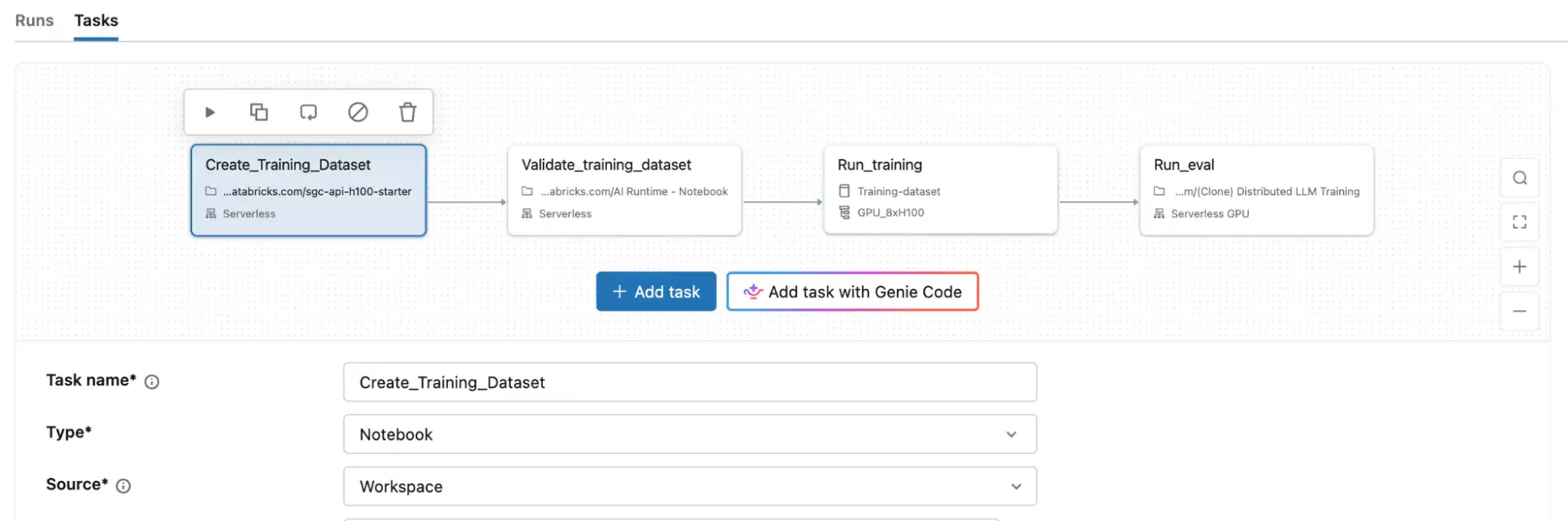
Databricks handles buying the GPU capacity, configuring clusters and the networking between machines. It runs health checks on GPUs before and during training and removes faulty machines automatically. Teams start a job from a notebook, an IDE or a single CLI command, and Databricks says jobs launch in seconds because it keeps warm pools of GPUs and loads container images lazily.
Training jobs sit under Unity Catalog, the same access-control layer that already governs a company's tables and files. The same permissions apply to the training data, the model checkpoints and the logs. Workloads are isolated at the virtual-machine level, with private networking options. GPU spend is tracked in Databricks' billing tables, broken down by workload.
What customers report
Superhuman moved a training job from one machine with 8 A100 GPUs to 16 H100 GPUs across several machines and cut training time from about 7 days to 48 hours. FactSet says setting up, training and deploying a custom model went from days to hours. Databricks also says its own research team used the platform to cut training time for a Qwen model by 6x.
Databricks has tested the system on training runs of more than 100,000 GPU hours.
Why the timing matters
As coding agents start running training experiments on their own, the number of experiments grows quickly, and so does the risk that sensitive training data leaks through infrastructure nobody is watching closely. Databricks' answer is to keep every run inside the governance perimeter that already exists for the data.
What it means for companies in Indonesia
Few companies need to train a large model from scratch. The realistic work for most Indonesian enterprises is fine-tuning an open model on company data: a customer-service model trained on past tickets, or a document model trained on contracts.
For that kind of work, the cost has often been the infrastructure. You need someone who can run GPUs, a second copy of sensitive data in another environment, and a separate set of access rules to audit. A managed runtime next to the data removes much of that overhead, and the training data keeps the access rules it already has.
Two checks before you plan around it. First, confirm the service runs in the cloud region your data residency rules require. Second, model the GPU cost per experiment. On-demand GPUs remove the setup work, but experiments add up quickly, especially once agents are launching them.
What to do next
Pick one model your business would actually use, and that needs your own data to be good. Estimate the GPU hours to fine-tune it, then compare the cost of running it on a managed runtime against building and staffing your own setup. Then decide who in the company owns the budget for experiments, before anyone, human or agent, starts running them.