
Google's AI used math to prove Signal's security code works, in 4 weeks
Google DeepMind's AI agents proved that the code behind Signal's encryption keeps its security promises, a check that has usually taken experts years. It points to a stronger kind of assurance companies can start asking their software vendors for.

The short version
- Google DeepMind used a team of AI agents to prove, with mathematics, that the code behind Signal's encryption keeps its security promises.
- The work took 4 weeks. Google says checking code this way has historically taken expert teams years.
- People still decided what to prove. The AI did the proving and flagged about 1% of its work for a human to review.
What Google DeepMind did
Signal's protocol is the set of rules that keeps chats private in apps like Signal and Google Messages. Billions of conversations depend on it. A single flaw in code like this could expose millions of people at once.
The usual way to check security code is testing. You try many attacks and see whether any get through. Testing can show that a flaw exists. It cannot show that none are left.
Formal verification goes further. It proves, step by step, that code always behaves as intended. Google calls it the highest standard of security assurance. It is also slow and needs rare experts.
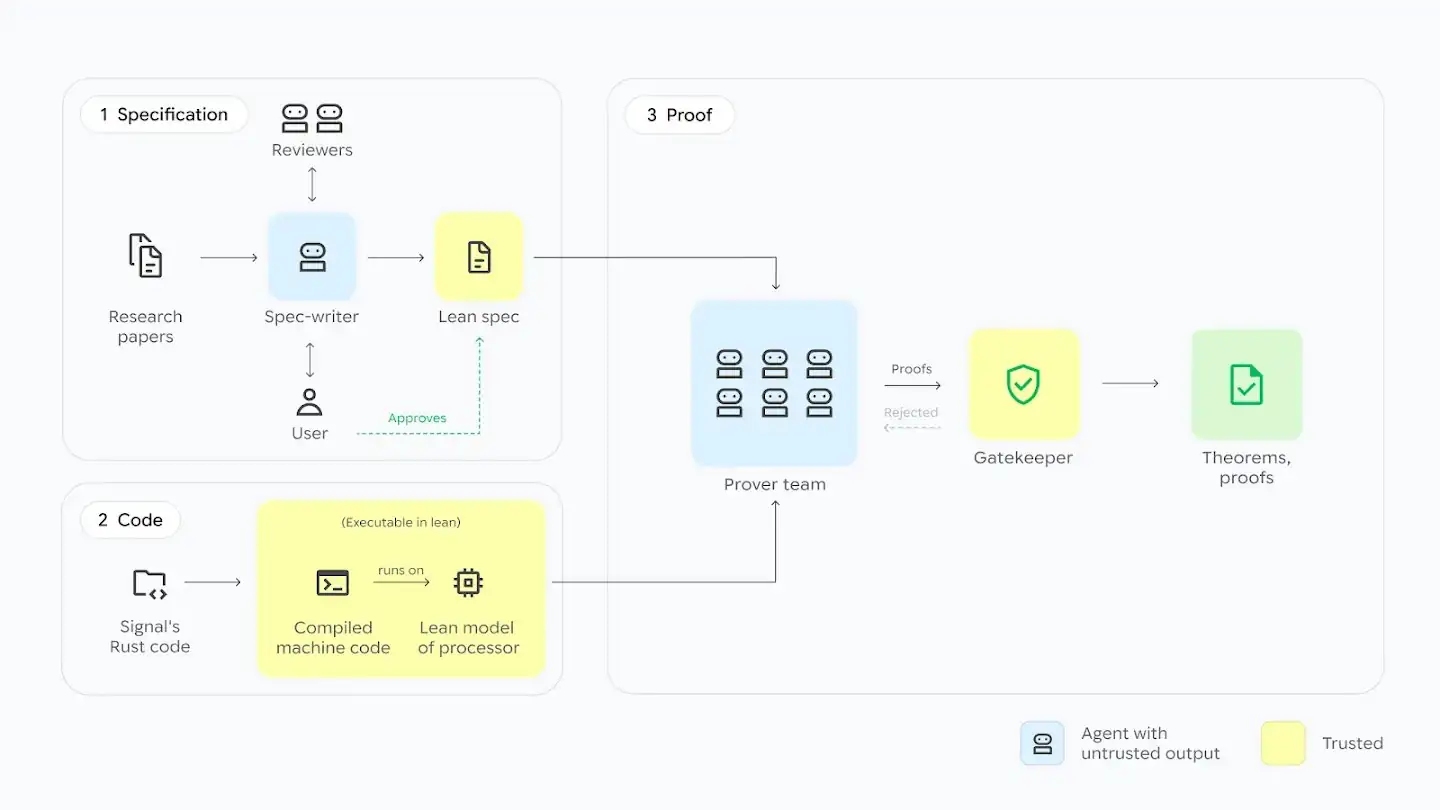
Google DeepMind built a system it calls AlphaProof Code to do that work with AI. It splits the job the way a research team would.
- People set the goals. Researchers worked with AI models to turn Signal's security promises into precise mathematical statements. Human experts reviewed every one.
- AI agents wrote the proofs. Agents running on Google's Gemini Carbon model wrote more than 6 million lines of proof in Lean, a language built for checking proofs.
- A machine checked the work. Lean confirms each proof automatically. The agents then marked the parts that needed a second look, about 1% of the total, for human review.
What is actually new
Security experts have studied encryption designs on paper for decades. Most of that work stops at the design. Real attacks often get in through the gap between the design and the code that actually runs on a phone.
Google says this is the first time anyone, with or without AI, has verified the running code of an encryption protocol this widely used.
The team also tested whether the system could tell good code from bad. They put back two real bugs that had been fixed earlier. In both cases, AlphaProof Code proved the buggy version was insecure.
Signal's chief technology officer, Ehren Kret, called the use of AI agents to turn live code into checkable proofs "a major breakthrough."
Google is releasing the proofs openly, along with a technical paper.
What it means for companies in Indonesia
Most companies will not verify their own code this way soon. The method still needs specialists and a lot of computing. But it changes what you can ask of the software you buy.
Banks and telcos run on encryption code written by others. Until now, "we tested it thoroughly" was usually the best answer a vendor could give. A mathematical proof that the code keeps its promises is a much stronger answer. Google itself points to medical device software and power grid systems as next candidates.
It also matters for defense. Attackers are using AI to find weak spots faster. Google pairs this work with CodeMender, its AI agent that finds and fixes security flaws.
For a board, the useful question is about risk. Which of your systems would cause the most harm if their security failed? Those are the first places where this level of checking will pay off.
What to watch next
- Ask your main software and security vendors whether they plan to use formal verification on their encryption code.
- List the systems where one flaw would expose the most customers, such as payments and customer logins.
- Watch for the open proofs to be reused on other common encryption code, which would make the method cheaper for everyone.
- Treat "AI-proven" claims with care until you know exactly what was proven. Here, people chose the goals. The proof only covers those goals.