
Google's new AI does hard office work for a third less than its top model
Gemini 4 Neon sits between Google's biggest and cheapest models. Google says it finishes a typical piece of hard work for 32% less than its top model, and it is on sale to businesses now.
The short version
- Google has released Gemini 4 Neon, a mid-price AI model built for long, demanding jobs such as detailed analysis and software fixes.
- At its default setting, Google says Neon finishes a task for 32% less than Gemini 4 Carbon, the model Google aims at its hardest projects.
- Businesses can use it today through Gemini for business. Pro and Ultra subscribers can also pick it in the Gemini app.
What Google released
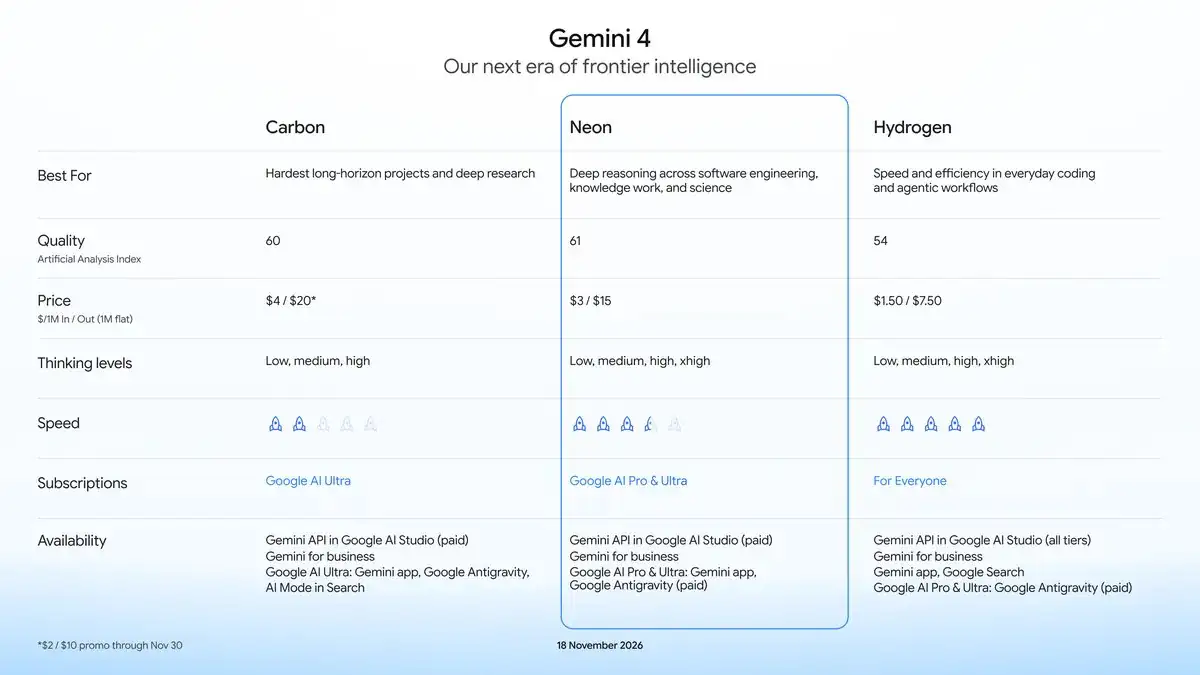
On 18 November, Google added Neon to its Gemini 4 family. Carbon takes on the hardest, longest projects. Hydrogen handles fast everyday tasks. Neon sits in the middle.
Google aims it at work that runs over many steps. Think of reading a pile of spreadsheets and PDFs, then turning them into a structured report. Neon can take in up to 1 million chunks of text in one go, which covers a very large stack of documents.
Outside rankings put it near the top. An independent testing firm, Artificial Analysis, ranks it third overall, with 61 points at Neon's highest setting. Only larger, slower models score higher. On the Vals Index, another independent ranking, Neon comes second. Google says it also came first on separate tests of legal research and tax work.
What is actually new
The headline claim is about the cost of a finished job. Google measures cost per task, meaning the total spent to complete one piece of work. That matters because a model that thinks longer writes more, so a low price per word can still mean a high bill.
At the default setting, Neon costs 32% less per task than Carbon. Against rival top models, Google puts the saving at roughly 50% to 80% per task.
Teams can also choose how hard Neon thinks. There are four effort levels. A higher level gives deeper reasoning and costs more, so you can match the spend to the job.
Google also says Neon makes things up less often. Google's internal tests recorded its lowest rate of invented answers yet. On a test that checks whether a model cuts corners, it took shortcuts on 2.45% of tasks, the lowest of any Gemini 4 model.
There is a security version too. Neon for cyber is built to find and fix flaws in software code. Google says it scored 90.5% on a test of finding code flaws, at roughly half the cost per challenge. It is going first to vetted security teams in Google's Fairwind Program.
What it means for companies in Indonesia
Strong AI is no longer sold only at the top price. Work you assumed needed Google's top model can now be tried on a cheaper one.
For a bank or telco running document-heavy work every day, a third off each finished task adds up quickly. The saving matters most on jobs that repeat: monthly reports, contract reviews, routine code fixes.
Treat the figures as Google's own claims for now. Google chose which test results to publish, and your work is different from any test. The only number that counts is the one you get on your own tasks.
There is also a data question. In the Gemini app, Neon can pull details from Gmail and Docs. That is useful, but it means you should know which company accounts staff have connected.
What to do
- Re-run a handful of your real AI tasks on Neon before your next renewal or budget review.
- Compare cost per finished task, including failed attempts, not the advertised price.
- Set the effort level per job. Keep the highest level for the hardest analysis.
- If you run a security team, ask your Google Cloud account team about the Fairwind Program.
- Check which Google Workspace data your staff let the Gemini app read.