
NVIDIA's new robot AI can pick up a hand skill from 5 human demonstrations
At a major robotics conference this week, NVIDIA released a robot AI model that picks up new hand skills from a few examples, plus tools that let robots practice delicate work in simulation first.
The short version
- NVIDIA introduced GR00T 2, an openly available robot AI model, at the Conference on Robot Learning in Austin this week.
- Shown each task once, it succeeded 71% of the time across 50 tasks. With five demonstrations, that rose to 95%.
- Factory users are already testing it, including Foxconn for automating server manufacturing.
What NVIDIA released
Robots have long learned to walk and roll in simulation. The new work is about fine hand skills: lining up gears, plugging in cables, assembling small parts.
GR00T 2 learns to predict what will happen around a robot when it moves. NVIDIA trained it on robot and human data, including 100,000 hours of video filmed from people's own point of view.
It can learn from a person showing the task, then move that skill to a different robot body. With no examples at all, it completed 40 of the 50 tasks at least once. Other AI software can guide it through a series of steps and help it recover from mistakes.
That matters because recording robot demonstrations is slow and costly. Learning from people doing the task, then moving the skill to another machine, cuts that work. NVIDIA also released a free tool that turns ordinary human video into practice examples for robots.
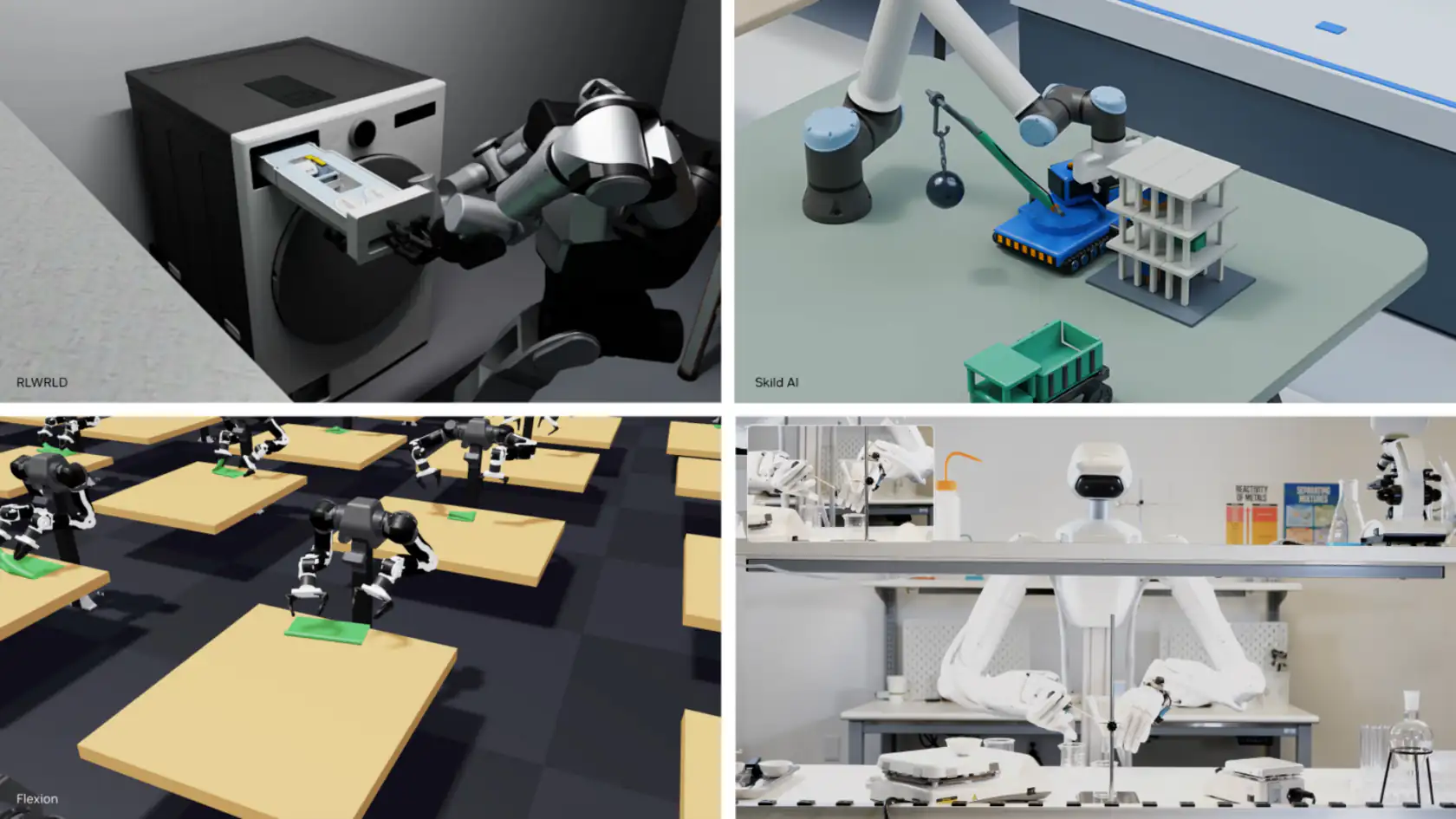
Early users span several industries. Nexuni is testing it for handling laundry. Siemens is evaluating it for industrial uses. MicroAGI trained it to swap network cables on a robot arm.
Practice before the factory floor
The second half of the news is about rehearsal. NVIDIA's free robot-training software, Isaac Lab, can now simulate soft and bendy objects such as cables and cloth. It can also model robot hands with many moving joints.
The new version trains up to 2.5 times faster than the last one on a hand-skills test. That means thousands of virtual robots can practice in parallel before a real one moves.
One example shows the payoff. A single robot program learned all 20 tasks on a standard assembly test board with parts a few millimeters across. It succeeded more than 98% of the time in training, against 81% when each task had its own program. It also needed about 39 times less computer time.
What it means for Indonesia
Many Indonesian factories run short product lines that change often. Teaching a robot each new task has been slow and expensive, which kept automation to long, repetitive runs.
If a robot can learn a task from a handful of demonstrations, automating small batches could start to make sense. Cable work, small-part assembly and packing are the kinds of jobs these results target.
Treat the numbers with care. They come from NVIDIA's own tests and lab settings. A humid, dusty plant with mixed parts is harder than a test board.
The practice tools may matter as much as the model. A robot that rehearses thousands of times in simulation breaks nothing on the real line. NVIDIA also released free software for testing robots across thousands of changing conditions. It shows which conditions cause failures, so engineers know what to fix next.
What to do next
- List hand tasks on your lines that change often and are hard to staff. Those are the first candidates.
- Ask your robot suppliers whether they can train in simulation before installing on site.
- Run a small pilot that measures how many demonstrations a task really needs in your plant.
- Keep video of skilled workers doing key tasks. Records like these are what these systems learn from.