
NVIDIA's recipe teaches AI agents local rules. Indonesia isn't in its 12 countries yet
NVIDIA published a workflow for tuning its open Nemotron models to follow local procedures, with synthetic residents built from national statistics. Singapore and Vietnam have persona sets; Indonesia does not yet.
NVIDIA published a step-by-step recipe on October 27 for teaching its open Nemotron models the rules of a specific country. The worked example is a French public-service assistant. NVIDIA's persona datasets, sets of synthetic residents built from national statistics, cover 12 countries.
What NVIDIA released
The new pieces are 2 persona datasets for France and Belgium, built with the French AI startup Pleias (Belgium also with the university KU Leuven). In the French set, each persona is a made-up resident whose age, town, job and household follow census data, plus a written profile of their work and daily life. The Belgian set spans 4 languages.
The recipe sits in NVIDIA's public Nemotron repository, alongside agent skills that help coding tools put the steps together. NVIDIA says it runs on a single DGX Station GB300 or DGX Spark, and can be adapted to other NVIDIA GPU systems.
Why local rules need their own training
NVIDIA's example is a French resident who can no longer travel for health reasons and asks how to apply for a passport. An untuned model tells them to send the forms by registered post. Mail is not an option for this case; the official rule is that an agent visits the person at home. After tuning, the sample answer asks for a medical certificate under 3 months old and explains the home visit.
Small facts change with the person. A passport stamp costs €43 for a resident of French Guiana and €86 in mainland France. A generic "French adult who needs a passport" never surfaces that difference. A persona who lives in Cayenne does.
How the recipe works
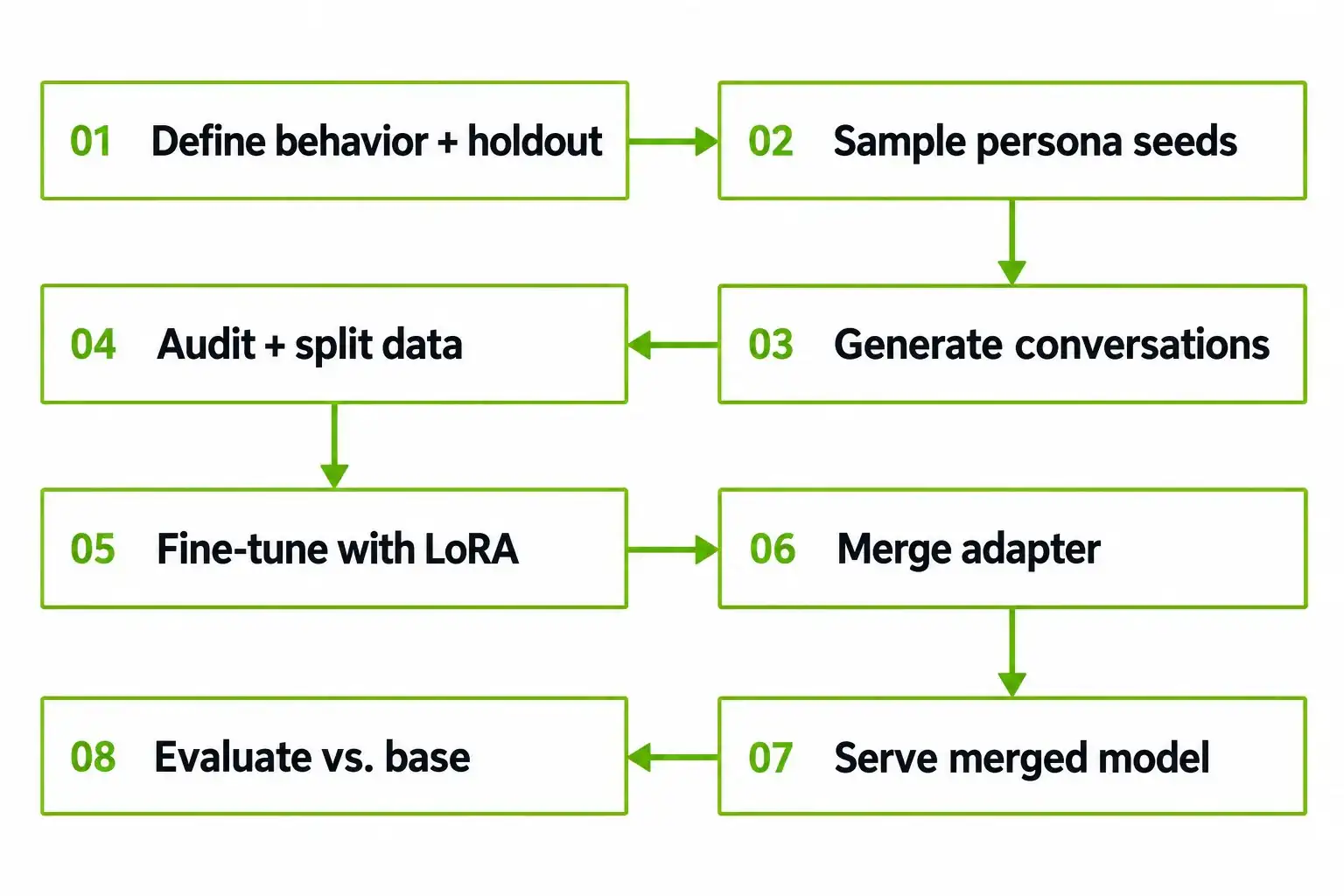
Before generating any data, you write a behavior contract: who the agent serves, what tasks it handles, how it should sound, which facts it may use, what it must never do, and how answers are laid out. In the French example, the agent may use only the official procedure text supplied with each question, must never ask for passwords or bank details, and must say so when it cannot confirm something like opening hours. NVIDIA recommends freezing a test set of 100 to 300 human-written or de-identified cases at the same point, before any training.
Then the recipe samples 2,000 personas, turns each into a customer question and an agent answer grounded in the official text, and has a separate model judge each answer. A script removes broken rows and any persona names that leaked into the data. The model is fine-tuned with LoRA, a lightweight method that trains a small add-on rather than the whole model, and compared side by side with the original on the frozen test set. NVIDIA recommends a human do that comparison and check every fact against the official pages.
What it means for companies in Indonesia
Indonesia is not on the list yet. The 12 published persona sets include Singapore and Vietnam in Southeast Asia, along with India, Japan and Korea. A team in Jakarta building a customer-facing agent for a bank would have to build its own synthetic residents, or adapt the method with another source of realistic customers.
The parts that carry over are the contract and the test set. The costly mistake in a customer-facing agent is a confident answer about a procedure or fee that is wrong for this customer, like the French postal route. Writing down which official texts the agent may rely on, and testing against cases where the right answer depends on where the customer lives, is how a team finds them before launch.
What to watch
This is a tutorial, and NVIDIA publishes example answers but no measured accuracy gain. It also states that grounding data in personas widens coverage and does not guarantee fairness. Watch for an Indonesian persona set in the Nemotron collection on Hugging Face, and for published before-and-after scores from teams that use the recipe.