
75% of Southeast Asian users would let an AI agent shop for them
The 11th e-Conomy SEA report puts the region's digital economy at $368B this year. When agents shop, product data decides who gets picked.
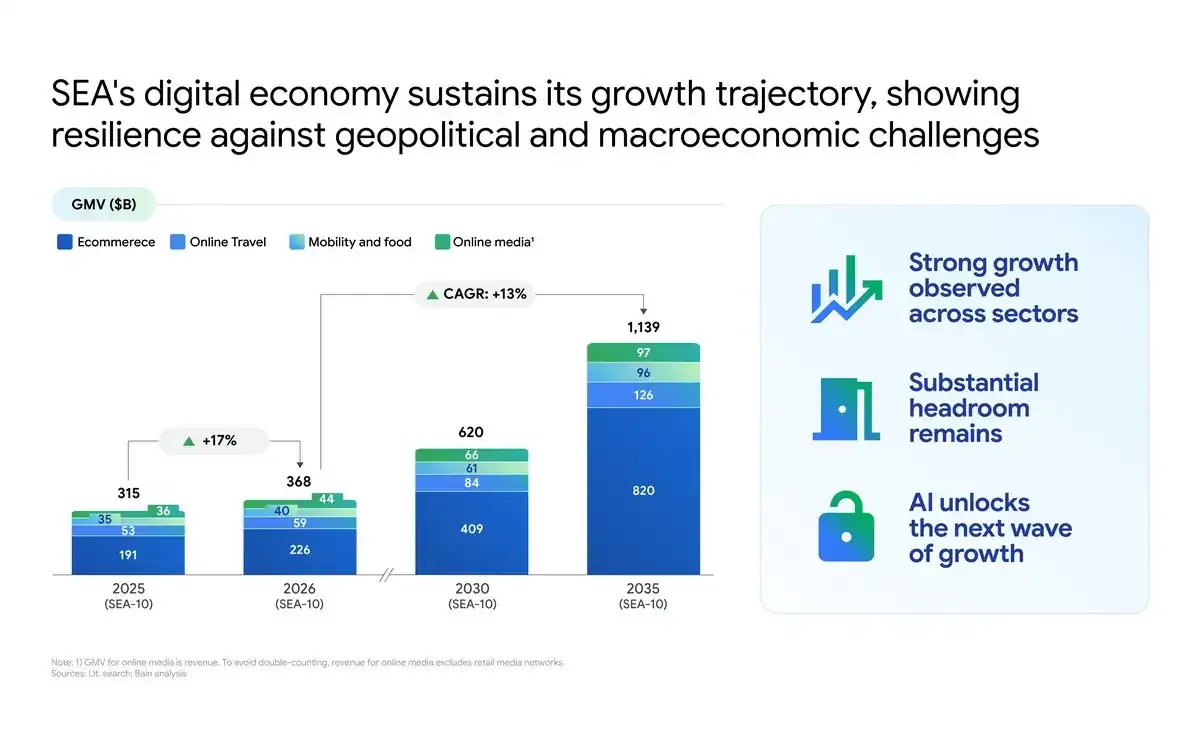
Southeast Asia's digital economy will reach $368 billion in gross merchandise value this year, up 17% on last year. The 11th e-Conomy SEA report from Google and Temasek, published on October 21, puts the region on course to pass $1 trillion by 2035.
Generative AI is now part of daily life for 243 million people in the region, 58% of the working population. The report says it is spreading four times faster than the mobile internet did.
Where the money is moving
E-commerce is still the anchor at $226 billion, growing 18%. The report credits AI shopping tools with 10% higher conversions and order volumes up by as much as 75% where personalized discovery is in place.
The other sectors are smaller but moving the same way. Online travel reached $59 billion, and generative AI has overtaken social media as the second most used tool for planning a trip, behind search. Online media earned $44 billion, up 22%, and commerce media is now a $4 billion market. Mobility and food delivery reached $40 billion. Digital financial services processed $1,650 billion in transaction value, up 16%, with AI used for real-time fraud detection and wider access to credit.
Shoppers are ready to let agents buy
72% of users already rely on simple automation such as price tracking. 75% say they would let an AI agent compare prices and complete a purchase for them. And 62% say they trust AI tools more than they did a year ago.
That trust comes with conditions. Users want privacy safeguards (44%), a clear statement of what the AI can and cannot do (36%) and the ability to reverse a transaction an agent made (30%).
The report measures the AI economy in tokens, the units models read and write, and projects a 60-fold rise in regional AI usage by 2030. The report expects growing confidence in agent-led shopping to drive that rise.
What has to be built first
Data center capacity needs to grow roughly 3x over the next five years. It points to Singapore's binding energy-efficiency rules for data centers and Malaysia's corporate renewable energy scheme as models. And it expects the ASEAN Digital Economy Framework Agreement, due in November 2026, to become the first region-wide digital trade pact anywhere.
What this means for a business in Indonesia
For a retailer or brand, the question is changing from "how do we rank in search?" to "will an agent choose us?". An agent comparing prices reads product data, stock, delivery terms and return policies. A catalog with vague titles, missing attributes or prices that differ across channels gives the agent a reason to pick someone else.
For a bank or payments company, the consumer data says people want to undo what an agent did. A clear way to reverse any agent-led transaction belongs in the design from the start.
For any company planning AI at scale, the region needs roughly 3x today's data center capacity, so plan where your compute will come from before you commit to the project.
What to do this quarter
Check that your product and service data is complete and consistent enough for a machine to compare, not only a person. Map which of your customer journeys an agent could finish end to end, and decide which ones you want it to. And when you plan AI projects, ask where the compute will come from.