
Amazon can now turn a few minutes of recordings into your brand's own voice
Amazon Polly can now copy a consenting speaker's voice and use it to read any script. It works in 7 languages, not yet including Indonesian, and companies must apply for access.
The short version
- Amazon Polly, Amazon's text-to-speech service, can now build a copy of a real person's voice from a few minutes of their recordings.
- The copied voice can then read any script, so a brand can use one voice in its phone lines and its ads.
- It launches in 7 languages. Indonesian is not one of them yet, and companies have to apply for access.
What happened
Amazon has opened voice cloning in Polly to customers who apply. You record one speaker who has agreed to have their voice copied. Polly then builds a voice that sounds like them and can say words they never recorded.
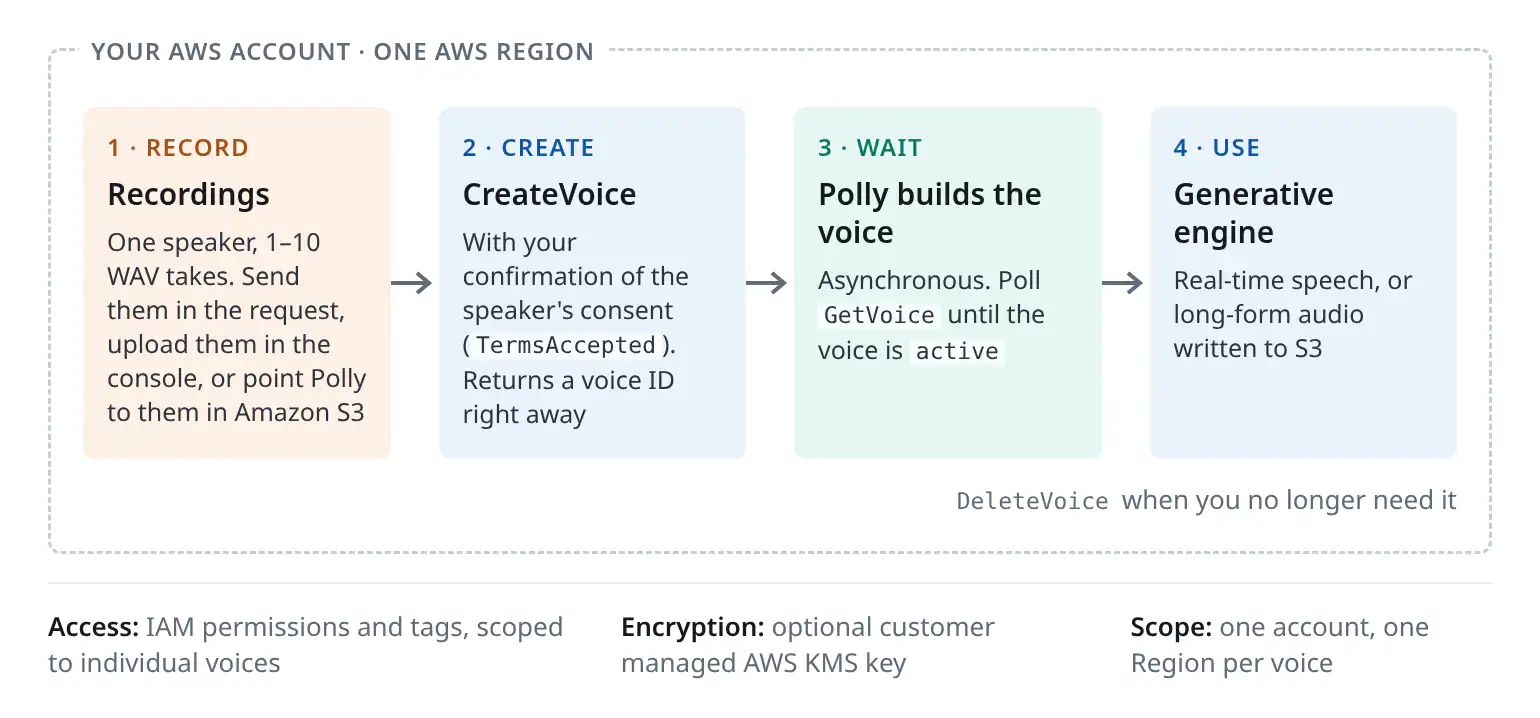
The process has four steps. You upload between 1 and 10 recordings and confirm you have the speaker's consent. Polly builds the voice in the background, which usually takes 5 to 10 minutes. After that, your systems can ask the voice to read any text, live or as a recording.
Building a voice is free. Amazon charges each time the voice is used, at its normal pay-as-you-go rates.
It launches in English and Hindi, plus five European languages such as Spanish and French. Each copied voice speaks only the language it was recorded in. A brand that wants its voice in several languages has to record a separate voice for each one.
What is actually new
Brands have long been able to pick a stock voice from a menu. The change is that the voice can now belong to you. It can be a known presenter or a voice actor you have hired for the brand.
Amazon's own examples show where it expects this to land:
- one recognizable voice from the phone menu to in-store announcements;
- contact center prompts that change with new offers or policies, without booking a studio session each time;
- audiobooks and online courses, where new chapters can be produced quickly;
- reading tools and other services where a natural, human-sounding voice helps.
Amazon has also built in several safety measures:
- You confirm the speaker's consent every time you create a voice.
- Speech made with a copied voice carries a hidden watermark.
- A copied voice can only be used by the account that made it, and it can be deleted at any time.
- Amazon says it does not keep the original recordings after the voice is built, and does not use them to train its own models.
Amazon also recommends keeping a record of each speaker's consent and deleting the voice if they withdraw it. Where appropriate, it suggests telling listeners they are hearing a synthetic voice.
What it means for brands in Indonesia
The obvious gap is language. Without Indonesian, a local brand can't yet use this for its main customer channels. It can still work for English-language channels and Hindi-speaking markets. If Indonesian is added later, the rules you set now will be ready.
The bigger change is in how voice work gets paid for and approved. Today, a voice talent records a fixed script for a fee. With a copied voice, the brand can keep producing new lines without the speaker in the room. Contracts with voice talent will need to say what a copy may be used for. They should also say how long it may be used, and what happens if the speaker withdraws.
Quality depends on the recording. Amazon's advice is practical. Record two to ten minutes of natural speech in a quiet room, with the same distance from the microphone. Avoid recording through meeting apps, because their noise filters change the voice and the copy learns those changes too. The copy also inherits the mood of the recordings. Cheerful recordings make a cheerful voice, so record in the tone you want.
A voice that customers learn to trust is also worth protecting. Tell customers which channels your brand voice will use to contact them.
What to do
- Decide whose voice your brand would use, and get written consent that covers AI copies.
- Update voice talent contracts so they cover AI copies and how consent can be withdrawn.
- Keep a consent record for every copied voice, as Amazon recommends.
- Test the service in English or another supported language before Indonesian arrives.
- Tell customers when they are hearing a synthetic voice, and which channels you use to contact them.