
Companies can now keep Anthropic's AI agent records on their own servers
A new invite-only trial lets firms host the whole system behind Claude's agents, including stored passwords and work records, in their own cloud or data center. The AI model itself still runs at Anthropic or a cloud provider they pick.

The short version
- Anthropic opened self-hosted Claude Managed Agents as an invite-only trial on 12 November.
- Companies can now run the whole agent service on their own servers or cloud. That covers the stored passwords and the record of every step the agent takes.
- The AI model itself still runs at Anthropic, or at a cloud provider the company chooses.
What Anthropic released
Managed Agents is Anthropic's kit for building AI agents. These are programs that work through a task on their own, such as fixing a broken software build or sorting alerts. Until now, Anthropic ran the service. Some teams could keep the agent's work space on their own machines, but the rest stayed with Anthropic.
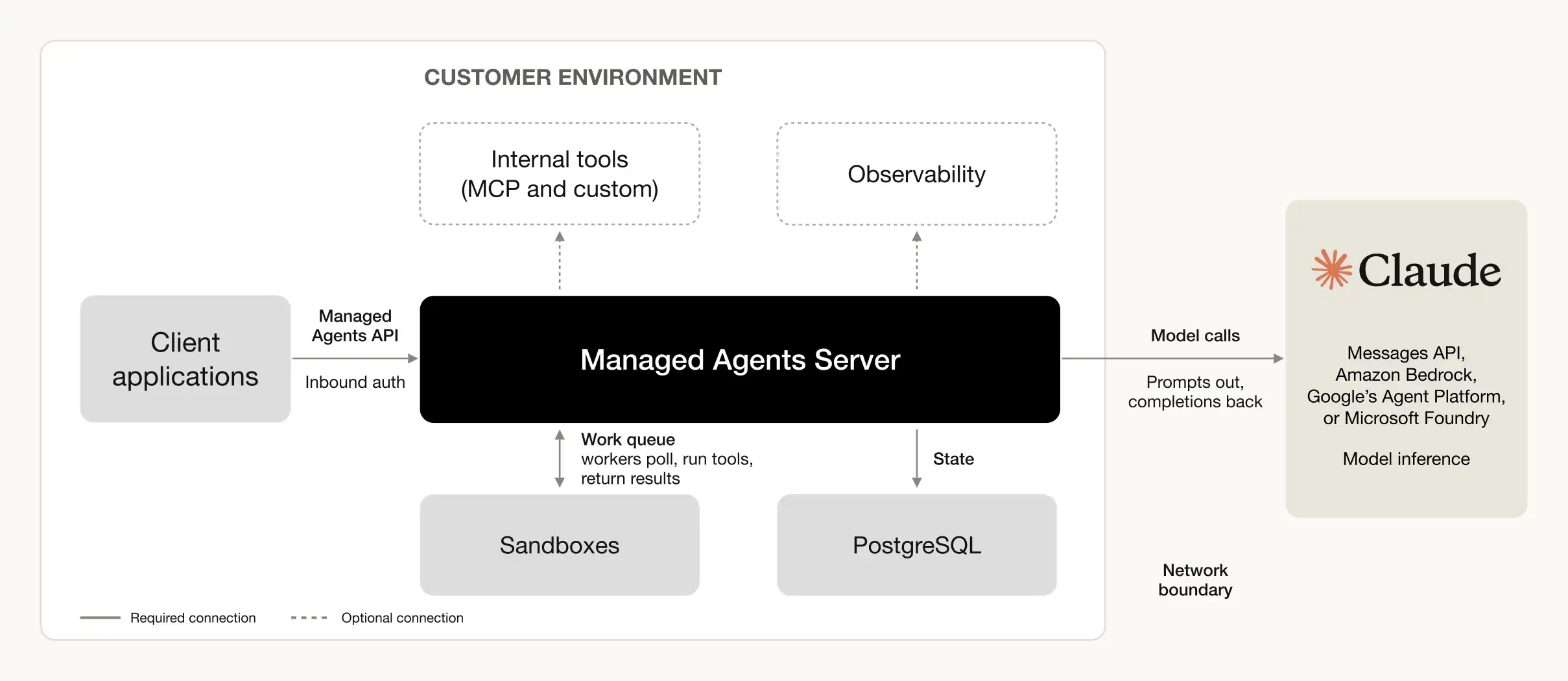
The new option moves everything else too. The company runs the server and its database. It also runs the workers, the machines where agents type commands and edit files. Session history, the log of what each agent did, sits in the company's own database. Passwords and keys can live in the company's own secrets store.
Calls to the model go where the company chooses. That can be Anthropic directly, or a big cloud provider's AI service, such as Amazon Bedrock. It can also go through a connection point the company runs itself. Developers use the same tools as on Anthropic's hosted service.
How it limits what an agent can do
Anthropic says it built the service on four safety principles. They apply however it is hosted.
- The part that thinks is kept apart from the part that acts. The agent's code runs in a walled-off space. Its memory and secrets stay outside it.
- Passwords stay out of that space. A separate gatekeeper adds them to each request on the way out.
- Each environment can be limited to a short list of allowed websites. An agent that fixes builds might only reach the company's code store and its software library.
- Every step is recorded, including each tool the agent used and what came back. The record can feed the monitoring tools a company already runs.
The trade-off
Hosting it yourself means securing it yourself. Anthropic's documentation says the customer takes over jobs Anthropic would normally handle. These include protecting the server and spotting unusual use.
The company installs each new release itself. Some features exist only on Anthropic's hosted version. The service also needs its own standard database. Without one, a restart wipes its data.
Each time the agent needs the model, the server sends the conversation so far to the model provider. That includes what the agent's tools found. The records stay home, but the working conversation still travels.
What it means for you
Many regulated firms in Indonesia, such as banks and insurers, want customer data and system records under their own control. This option lets them use Claude's agents while keeping those records inside their own walls.
It also gives security teams something they can inspect. A short list of allowed sites and a full log of every step are easier to approve than a black box. The cost is staff time, because someone has to run the server and keep it patched.
What to do
- If your rules require agent records to stay in-house, ask your Anthropic account team for access.
- Map what data an agent would send to the model, since the conversation still travels to the provider.
- Start with one narrow job, such as fixing failed builds, and keep its allowed websites to the minimum.
- Budget for the staff time to run the server and keep it updated.