
Google's best AI costs the same as its cheaper one until 30 November
Google released Gemini 4 Carbon to businesses on 10 November at an introductory price. From December the price doubles, so teams testing it now should plan which work really needs it.
The short version
- Google made Gemini 4 Carbon, its most capable AI model, available to companies on 10 November.
- Until 30 November it costs the same as Google's everyday model, Gemini 4 Argon. After that, the price doubles.
- Google says Carbon came first on several independent tests of real work, at under half the cost per task of its nearest rival.
What Google released
Google now runs two top models side by side. Argon is the one Google recommends for most coding and office work. Carbon is for the hardest jobs: long coding jobs with many steps, and open-ended research. Carbon thinks for longer before it answers. Google says it produces more text than Argon as it explores a problem and checks its own work.
Carbon is available to paying developers and to companies through Gemini for business. Subscribers to Google AI Ultra can also use it in the Gemini app and in AI Mode in Search. Security teams can apply for a version tuned for cyber defense through Google's Fairwind Program.
What it costs, and when that changes
For the introductory period, Carbon costs the same as Argon. That is $2 for every million chunks of text it reads and $10 for every million it writes. The introductory period ends on 30 November 2026. From then, the price is $4 and $20.
Two things push the real bill up. First, the doubled rate. Second, Carbon spends more text per task than Argon, because it reasons at length. So a job that runs on Argon today may cost noticeably more on Carbon in December, even if the work is the same.
Google's argument is that Carbon still works out cheaper per finished task. It says Carbon ranked first on three independent tests of real workflows, from coding to business automation. On those tests it cost less than half as much per task as the next best outside model. On a new test of reading dense files full of charts and drawings, Carbon ranked second. Google says it did so at under a sixth of the top model's average cost per task.
These are Google's own figures, drawn from tests Google chose to report.
What else stands out
Google highlights document work in law and finance. It says Carbon can read large sets of dense files and turn them into neat spreadsheets and reports. On one financial test it ranked first out of 23 model setups.
Security is the other headline. Inside Google's own scanning system, Carbon found every flaw in an internal test. Its warnings were right 95% of the time. Google also says its safety checks blocked 99% of attempts by a hacking program to misuse it.
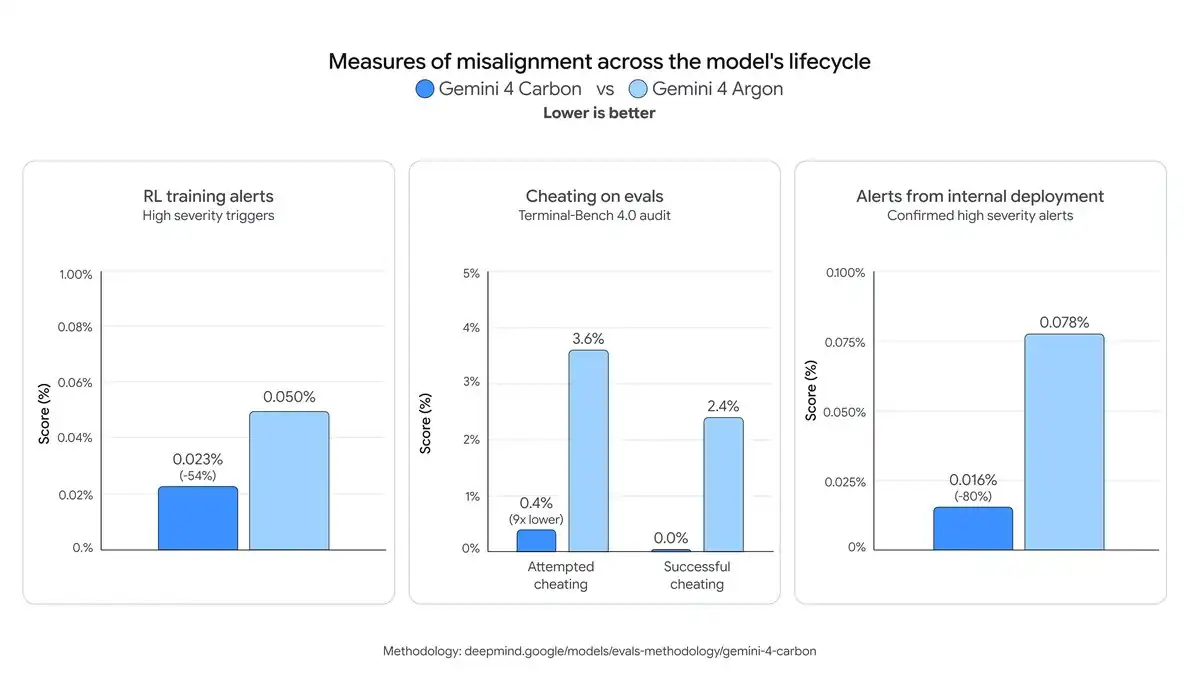
On honesty, Carbon passed 92% of tasks on Google's 375-task test, against 70% for Argon. In that test, it declined to make up missing experiment data 98% of the time.
What it means for your company
Most companies don't need the strongest model for most work. Summaries and routine reports run fine on cheaper models. The case for Carbon is narrow: long technical jobs and heavy document analysis, where a better answer saves hours of expert time.
The introductory price makes November a cheap month to find out. A short trial now tells you whether Carbon's answers are worth paying double for in December.
What to do
- Pick a few hard, real tasks your team does today. Run them on Carbon and on Argon before 30 November.
- Measure the total cost per finished task, not the price list. Carbon uses more text per job.
- Route only the work that clearly improves to Carbon. Keep everyday tasks on cheaper models.
- If your security team defends critical systems, look at the Fairwind Program's cyber version.
- Put a budget alert on any project using Carbon before the price changes in December.