
Indonesia's 508 local governments should share AI tools, says Komdigi
Deputy minister Nezar Patria says regions should stop building their own chatbots and reuse shared parts, such as language services and complaint modules, to save budget.
The short version
- Indonesia's deputy minister of communication and digital affairs, Nezar Patria, says local governments should share AI building blocks.
- He named reusable parts that all 508 districts and cities could use. His examples were language services and complaint modules.
- He also proposed AI Public Service Labs, where universities and civil servants would work with businesses to design and test AI tools.

What Komdigi said
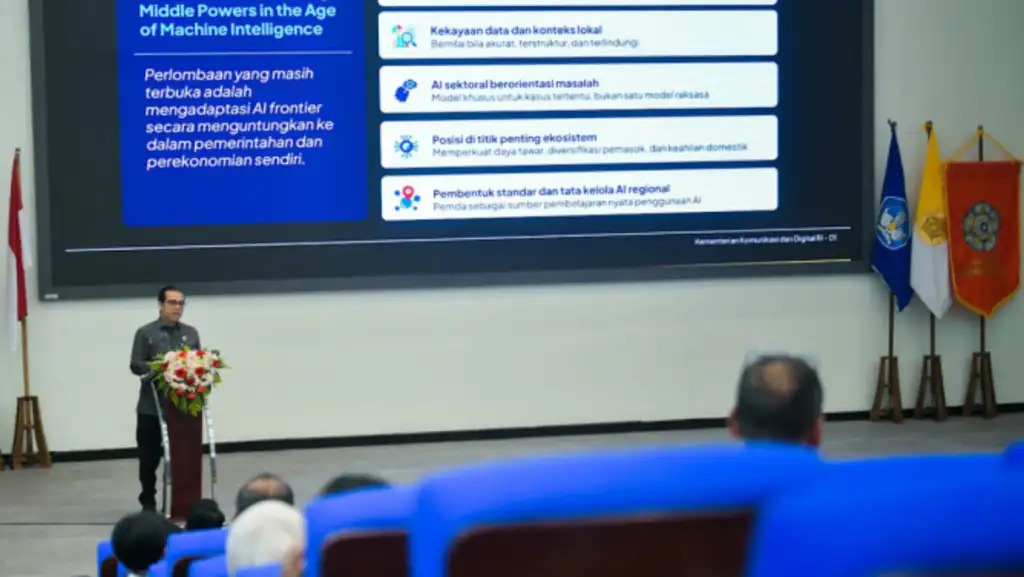
Nezar spoke on 5 November at Universitas Gadjah Mada in Yogyakarta. He was speaking at the event for the 2026 Gadjah Mada Digital Transformation Governance Index, a yearly measure of how digital each region is. Komdigi published his remarks the next day.
His point was about money. Regional budgets get spent building systems that already exist somewhere else. He pointed to Estonia, which brought many separate government chatbots together.
"There is no need to build 508 chatbots separately," Nezar said, referring to Indonesia's regions.
The shared parts he listed were language services and a complaint-handling module, plus common data standards. If regions reused them, he said, the savings could go to local problems.
He also argued that AI is a different kind of change from earlier digital projects. Older technology made public services faster. AI, he said, also helps governments weigh policy choices and design services around what citizens need.
A lab to test before scaling
He also proposed an AI Public Service Lab. Students and lecturers would work with civil servants and businesses. Community groups would join too. Together they would pick a problem and design an AI fix. They would test it in a small trial and measure the impact before expanding it.
Nezar said regions should start from real service problems, from village offices up to city halls. He said the people doing this need skills in planning AI adoption, handling data, cyber security and ethics. Regions could build those skills by working with universities such as UGM.
The index now covers all 508 districts and cities, up from 429 two years ago. It scores each region on seven pillars and 50 indicators. Nezar said its purpose is to show each region where it stands and who it can learn from, more than to rank winners.
What it means for you
This is a proposal in a speech. No rule or budget has been announced yet.
It does show where the ministry wants public AI spending to go. A supplier that builds a custom chatbot for each region may soon meet buyers asking for shared, reusable parts. Firms whose language tools or complaint systems can serve many regions at once look better placed.
Banks and telcos that link into local government services should expect more talk of common standards. A shared standard can cut the cost of connecting to hundreds of regions at once.
Universities get a new role too. If the labs go ahead, they would become testing partners for local government. That puts campuses like UGM between the ministry's plans and the offices that serve citizens every day.
The logic is simple. One part built well and reused 508 times costs far less than 508 separate builds.
What to do
- If you sell to regional governments, check whether your product could work as one shared part across many regions.
- Watch for Komdigi guidance on common data standards and shared language services.
- If the labs launch, consider offering to join one near you.
- Use the Gadjah Mada index to see which regions are most digitally ready, and start there.