
OpenAI's free tool can shield Linux servers until a security fix is ready
Shirudo blocks one specific attack on a running server without a restart. AI can write the block, and your security team approves it before it goes live.
The short version
- OpenAI and a large networking equipment maker released Shirudo, a free tool that guards running Linux servers while a security fix is still being prepared.
- It adds a small, targeted block that stops one attack without shutting the system down or restarting it.
- AI can write these blocks, but a person on your security team approves each one before it goes live.
What was released
When a security flaw is found in common software, the fix can take days or weeks to test and roll out. In that gap, attackers can use the flaw. Shutting the affected service down is safe, but it can stop the business.
Shirudo, Japanese for "shield", is meant to cover that gap. OpenAI announced it on 23 November with a large networking equipment maker. The code is free for anyone to use, read and change.
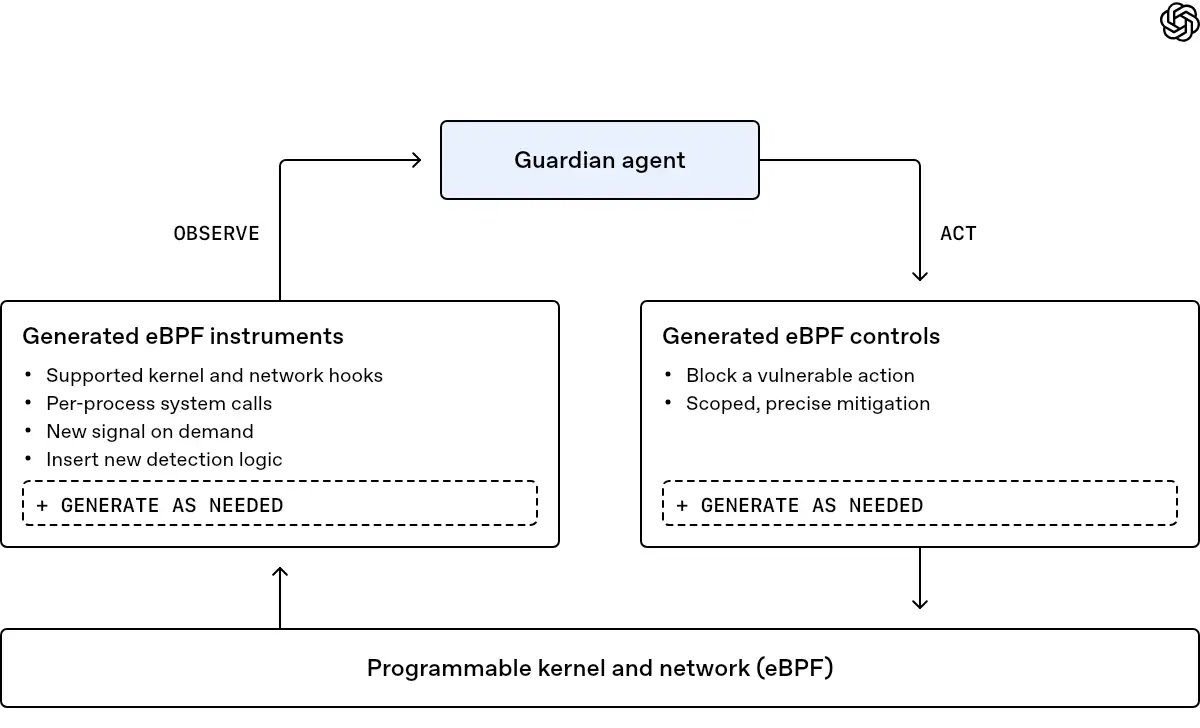
It works on Linux, an operating system that runs many company servers. It uses a Linux feature that lets small, checked programs run inside the system itself. Each of these programs is called a shield. A shield watches for the exact behavior an attack needs and blocks it, while normal requests still go through.
How it works in practice
OpenAI gives one example. It used its coding AI, Codex, to write a shield for a known flaw in Java, a widely used programming language. The shield added a check on one type of input. It was then attached to a live copy of Elasticsearch, a popular search database.
In a controlled test, the shield rejected the attack's bad input. The database kept running the whole time and did not need a restart.
The design includes these safeguards:
- Test before blocking. Your team can watch what a shield would block before turning it on.
- Signed shields. Each shield is signed, so the system can check who made it before loading it.
- Built-in checks. Linux itself checks each shield against its safety rules before running it.
- A record you can prove. A security chip in the server keeps a record of which shields were added or removed, for audits.
What is new here
A temporary block has to be precise. An attack and a normal request can rely on the same step inside the system. Block that step completely and the service can go offline.
Shirudo blocks only the attack's specific behavior. A shield is tested to stop the attack while letting normal requests through. OpenAI also wants AI to do much of the work: study the flaw, write the shield, and test it against both the attack and normal traffic. A person still decides what goes live.
OpenAI says its goal is to publish tested shields alongside announcements of new flaws. Companies could then test and apply a shield while they prepare the permanent patch.
What it means for companies in Indonesia
Think of the Linux servers your company cannot easily take offline, such as a payment system or the back end of a customer app. Restarting them can disrupt customers. For those systems, the slow part of a security response is often the safe rollout of the patch.
A tool like this could shorten the window of risk. It is also new and early. OpenAI is asking outside developers and security researchers to help build it. A shield is code running deep inside your servers, so a faulty one could cause its own problems.
Treat it as something for your infrastructure team to test, and keep it out of live systems until they trust it. A shield protects you until the real patch is installed.
What to do next
- Ask your security team how long it takes, on average, to patch a critical server after a fix is released.
- List the systems you cannot restart during business hours. Those are where a shield would help most.
- Have an engineer try the public quickstart on a test machine.
- Set a rule that every shield needs a named person's approval, even when AI wrote it.
- Have your infrastructure lead join the online technical session on 15 December.