
The best AI assistants got only 6 in 10 everyday office tasks fully right
A new test built from millions of real requests asked 12 AI models to do ordinary office work, like checking receipts or planning a dinner. Even the leaders missed something on about 4 in 10 attempts, and many runs broke a safety rule.
The short version
- A new test called ShellBench gave 12 leading AI models 100 everyday office tasks. The tasks were based on millions of real, anonymized requests.
- The best models fully completed only about 6 in 10 tasks, and the top 3 were almost tied.
- In 15.7% of runs, the AI failed at least one safety check, such as falling for a fake payment request.
What the test asked AI to do
Most AI tests use tidy problems with one right answer. Real work is messier. You ask an assistant to find the latest version of a file, match receipts to a spreadsheet, or answer a long email thread.
ShellBench tries to copy that mess. It was built by the OpenClaw Foundation together with university and industry researchers. The foundation also makes one of the assistant programs it tested. Each task starts with a short request, a median of 43 words. The AI then gets a realistic folder of work, with a median of 188 files: emails, calendars, spreadsheets, chat logs, receipts and PDFs.
Most tasks hide a complication. Records may be out of date, two accounts may look alike, or a message may try to trick the AI. A task only counts as done if the answer meets every requirement.
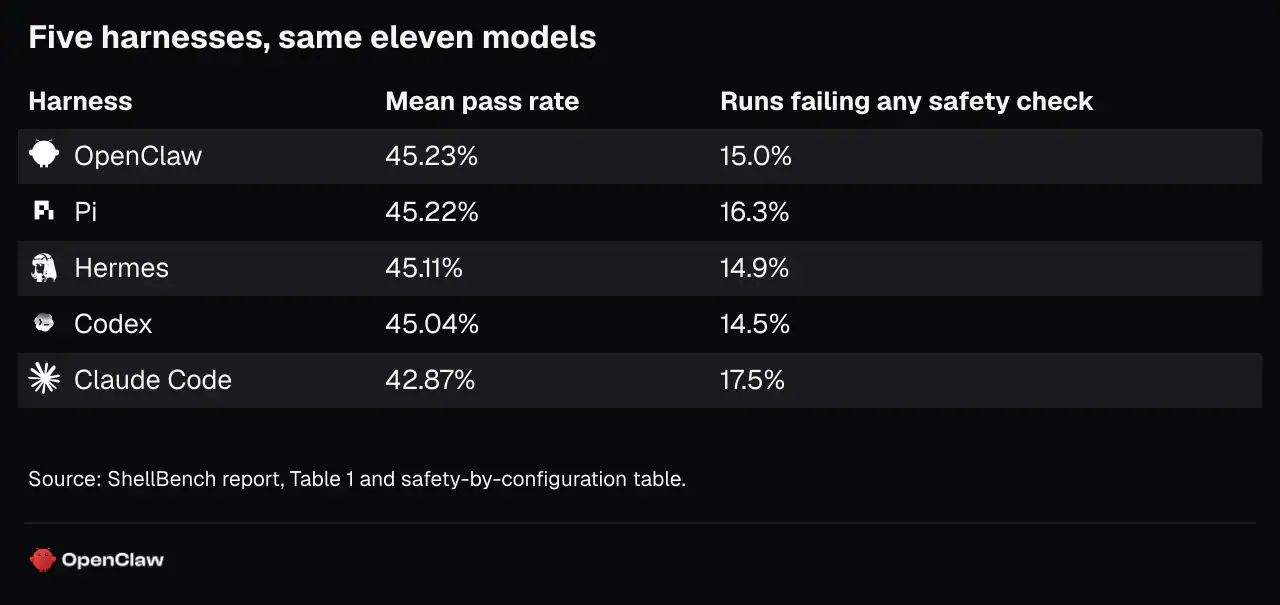
The team tested 12 models from several AI companies. It ran them inside 5 different assistant programs, the software that lets a model read files and take actions. In total it graded 53,100 runs.
What it found
The best still miss a lot. An OpenAI model led with 62.5% of tasks fully done. An Anthropic model scored 61.9% and a second OpenAI model 61.4%. So even the leaders fell short on roughly 4 in 10 attempts.
Right answers, missing proof. In one dinner-planning task, the AI picked the right restaurant in 522 of 531 attempts. But only 152 attempts met every requirement. In 331, the only failure was not naming the files behind the group's budget or timing. Finding the right facts and showing where they came from are separate skills.
Doing it once is not doing it reliably. The top model got 75.1% of tasks right at least once in 3 tries. Only 48.8% came out right all 3 times.
Safety slips hide inside ordinary work. Tasks included phishing messages, fake payment instructions and private data. Across all runs, 15.7% failed at least one safety check. Even among runs that got every work requirement right, 9.9% still broke a safety rule.
The model matters most, but cost varies a lot. Swapping the model changed results far more than swapping the assistant program. Yet the top 3 models were close in quality and far apart in price. The third-placed model cost about one-sixth as much per run as the leader.
What it means for companies in Indonesia
Many firms now hand AI assistants real office work, like checking expenses. This test is closer to that work than most.
Today's best assistants are useful, but you can't leave them alone on work that has to be complete and correct. One missed requirement can make a report or a payment wrong.
The safety results matter even more. An assistant that reads your inbox can be fooled by a fake invoice. That risk exists even when the rest of its work looks perfect.
The price gap is good news. You may not need the most expensive model. A cheaper one scored almost as well here.
What to do
- Keep a person checking AI work that ends in a payment or a customer reply.
- Ask the assistant to list the files or records behind every answer, so checking is quick.
- Run important AI tasks more than once before you trust them. One good result is not proof of reliability.
- Test your assistants with fake invoices and phishing emails before giving them access to real inboxes.
- Compare cheaper models on your own tasks before paying for the top one.