
Xiaomi's free AI reads scanned documents on your own computers
Xiaomi has released a small, free AI model that turns scanned and photographed documents into clean text, tables and fields. It topped a demanding real-world test, and it is small enough to run on your own machines.
The short version
- Xiaomi released a small AI model that reads documents. It pulls out the text and tables, plus key fields.
- It ranked first on a test built from real, imperfect document photos, ahead of larger rivals.
- It is free to download, and a ready-made local version is only about 1.8 GB, so documents never have to leave your own computers.
What Xiaomi released
OCR, short for optical character recognition, is the technology that turns a picture of text into text a computer can use. Banks and insurers run it on forms and invoices every day.
Xiaomi's research team has released a new OCR model on Hugging Face, the main public site for sharing AI models. It came out on 30 September with a technical report. It is now spreading through the developer community. The license, Apache 2.0, allows business use.
The model can also understand a page's layout. It can:
- turn a whole page into structured text, keeping the reading order;
- rebuild tables and mathematical formulas;
- pull out a specific field, like a customer's name;
- answer questions about what a document says.
It also copes with messy input. Xiaomi says it stays stable on scanned and photographed pages, even warped or tilted ones. That is what real paperwork looks like.
What is actually new
The news is the size. Xiaomi started from one of the smallest models in Alibaba's Qwen family. It then trained it on about 170 million document examples. The result is tiny by AI standards.
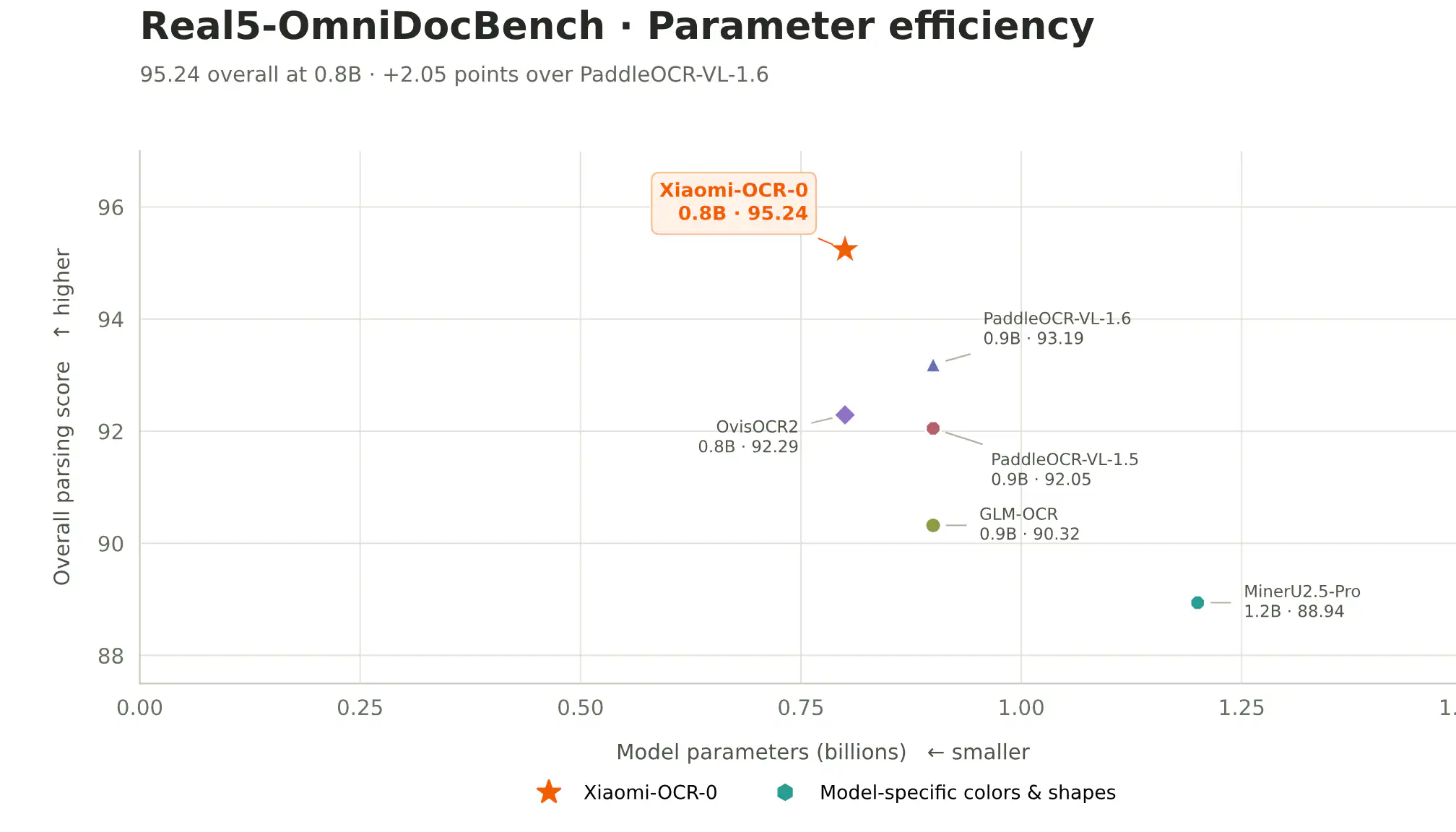
It ranked first on a standard test made from real-world document photos, with a score of 95.24. Several larger OCR models scored lower. On a broader test of answering questions about documents and charts, it beat a Qwen model more than twice its size.
A small model matters for two reasons. It is cheap to run on large volumes. It can also run on a company's own computers, with no outside service involved. A community-built version for local use is about 1.8 GB.
Xiaomi is careful about one point. It has not checked the community-made versions itself, so their accuracy may differ from the original.
What it means for companies in Indonesia
Paperwork is still a large hidden cost for Indonesian banks and insurers. KTP copies and claim forms are often photographed on a phone, then typed in by hand.
A free, small model that can run inside your own network changes the math. You keep customer documents on your own servers, which helps with Indonesia's data protection law. You also avoid paying per page to an outside service.
There is a gap to check. Xiaomi's tests are mostly on English and Chinese material, and the model card does not mention Indonesian. Before relying on it, test it on your own documents. Include handwritten pages and poor phone photos.
What to do next
- Pick one paperwork-heavy process, such as supplier invoices. Gather a few hundred real samples.
- Test the model on those samples and measure how many fields come out right.
- Compare the result and the cost with the OCR service you use today.
- Keep a person checking important fields while you build trust. Amounts and ID numbers matter most.
- Run it inside your own network if the documents contain personal data.