
AI assistants do better with fewer notes they check, Anthropic finds
Anthropic studied how its Claude models remember things between sessions. Small, tested notes beat big archives, and letting the AI check its notes against past work fixed wrong ones.

The short version
- Anthropic tested how its AI keeps notes from one work session to the next. Fewer, well-chosen notes worked far better than saving everything.
- Letting the AI review its notes against what really happened, a step known as "dreaming", caught and fixed wrong notes.
- On hard merger questions, an AI-built company wiki scored 87%, against 73% for search alone.
What Anthropic studied
An AI helper usually starts each session with a blank slate. To learn from experience, it needs memory: notes it writes down and reads again later. Anthropic, which makes the Claude models, has published research on how to make that memory useful.
One test had Claude play the video game Pokémon Red, a long task where the situation keeps changing. An older model saved almost everything. After about 10,000 moves it had written 413 memory files across 225 folders, and had earned one badge, the game's mark of progress. A newer model wrote nine files and one summary page, and earned four badges.
The older model wasted time keeping its huge record up to date. At one point it spent 17 moves creating and deleting files without playing at all. The newer model only wrote down things it could not see on screen: its goal and plan, plus rules it had tested.
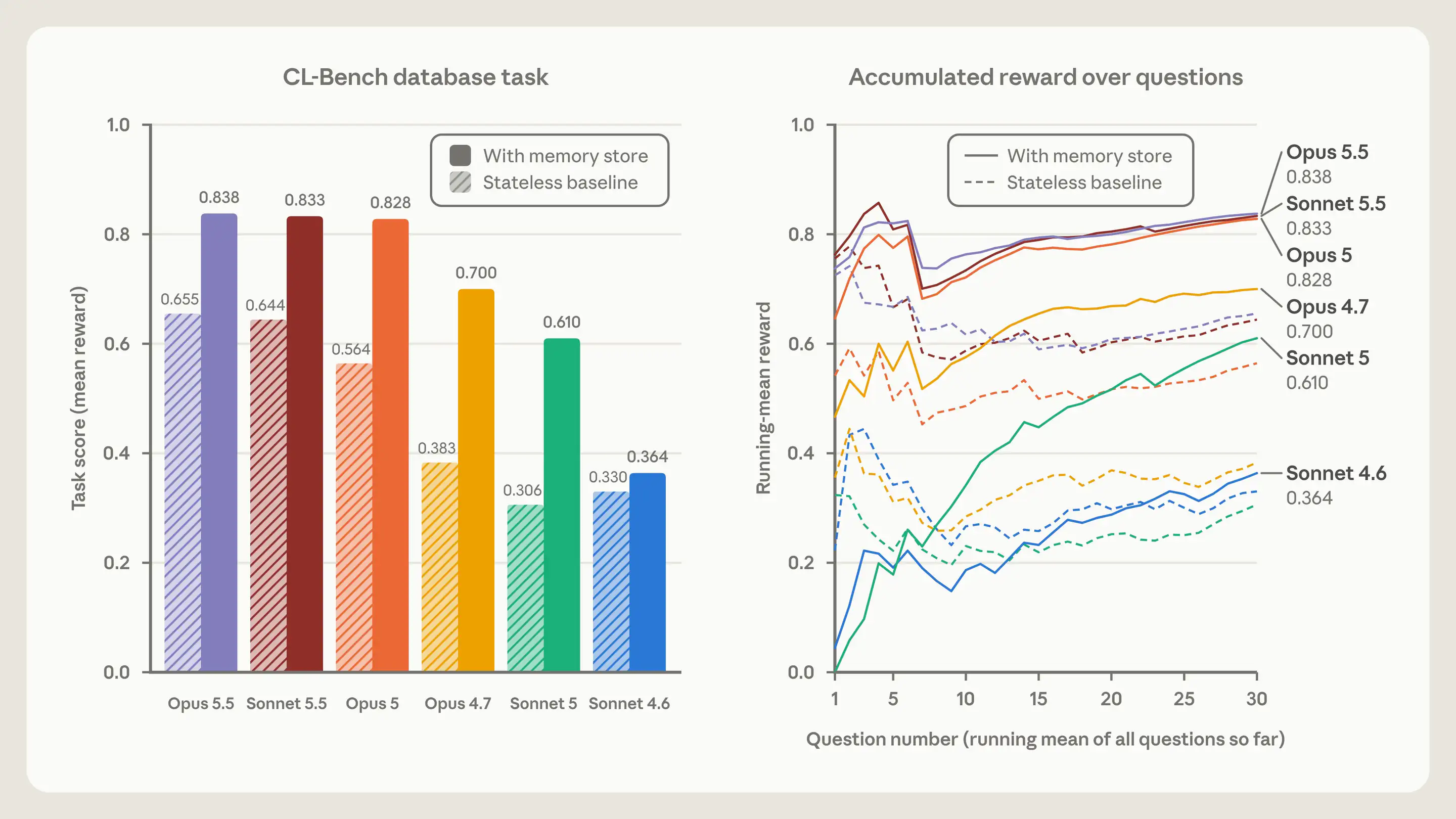
A second test asked models to answer database questions and learn from each wrong answer. The newest models wrote down a rule, how they knew it was true, and traps to avoid. Older models left scattered guesses.
Telling the AI how to remember can backfire
Anthropic also tried giving the models fixed rules about what to save. Telling stronger models to "record only failures" cost them much of the benefit memory had given them. They did better when told only that memory existed and left to judge.
Older models were different. Prompting one to read its notes before answering, and to test its theories, nearly doubled its score.
Checking notes later fixes mistakes
Notes can be wrong from the start, or go out of date. Anthropic uses "dreaming", a separate pass where the AI checks its notes against the full record of past sessions.
In the game, Claude once wrote down the wrong side of a mountain for a landmark. With that note, it kept walking off a ledge and never reached the next city. After dreaming caught and corrected the note, it went straight through.
Dreaming can also build a company wiki, a set of linked pages about one subject. On a pile of about 350,000 internal files from a software company, the AI built a wiki over many sessions. Its score on 25 questions rose from 13% to 48% as the wiki grew.
On questions about a merger, most of which needed facts from several documents, Claude scored 87% using its wiki. It scored 73% using search alone. When the answer sat in a single document, the wiki added nothing clear.
What it means for companies in Indonesia
Many firms are now testing AI helpers that work over days or weeks, handling customer cases or preparing reports. Memory is what lets them improve instead of repeating mistakes.
The research suggests two practical lessons. First, a few good notes work better than a big archive. And a wrong note that the AI trusts can do more harm than no note at all, so the notes need checking.
One example showed how much instructions matter. When the AI was building a wiki of contract terms, several helpers wrote to one shared table and overwrote each other. Only 41 of 57 key facts survived. Giving each contract its own page, with the terms quoted word for word, kept all 57.
What to do next
- If you are testing an AI helper with memory, ask what it saves and how often it is checked.
- Keep the notes it loads into every session short. Push detail into pages it can look up.
- For contracts and other exact wording, tell it to quote rather than summarize.
- Plan a regular review of the AI's notes, the way you would audit a shared file.