
Two AI models did the same coding work, but one cost 32x more
Databricks has published what thousands of companies actually use and spend on AI. The model with the lowest price list often costs more in the end, and most firms now use more than one AI supplier.
The short version
- Databricks has launched a public index of the AI models companies use and what they pay for them.
- In its tests, two models solved the same share of coding tasks, but one cost $0.05 a task and the other $1.62.
- Companies relying on a single AI supplier fell from about 64% in July to 28% by early November.
What Databricks published
Databricks sells a data platform that many large companies use to reach AI models from different suppliers. That gives it a view of real usage across more than 10,000 companies. It has now turned this into the Databricks AI Index, a public page it plans to update weekly.
The index has two parts. One tracks which models companies use and how much they spend, based on anonymous, pooled data. The other tests models on real coding jobs from Databricks' own engineers, such as fixing problems. The current data covers 21 September to 7 November 2026.
Price per word is the wrong number to watch
AI suppliers set prices by how much text a model reads and writes. Databricks found that this price tells you little about the final bill.
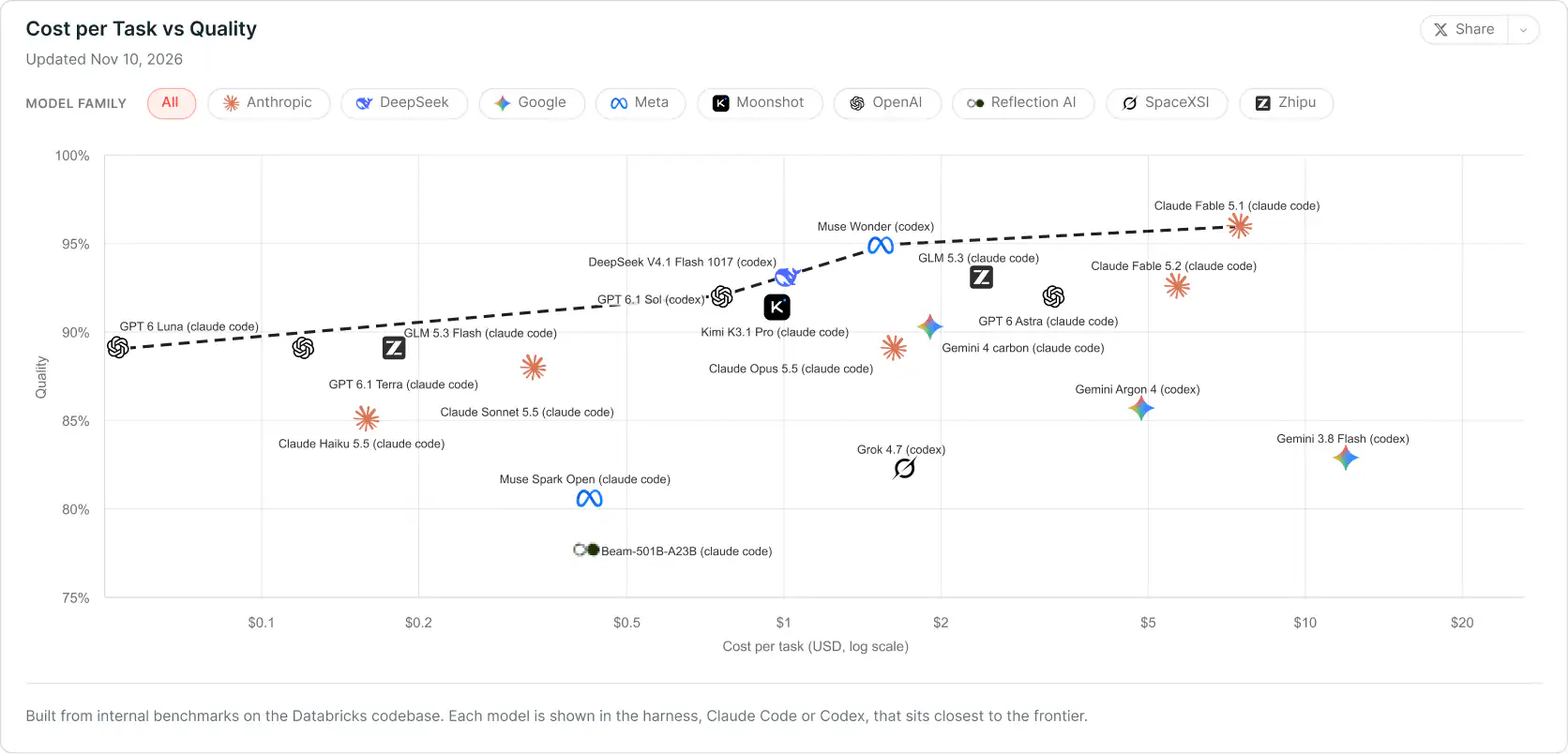
Some models take many more steps or retries to finish a job, and each step costs money. In the coding tests, an OpenAI model and an Anthropic model both finished 89.1% of tasks. One averaged $0.05 per task and the other $1.62, roughly 32 times more.
The reverse also happens. One of Google's low-priced models averaged 140 steps per task. It ended up among the most expensive, at $11.97 per task.
The top-scoring model was not the best value either. The top scorer finished 96.0% of tasks at $7.47 each. A Meta model finished 94.9% at $1.53. That small gain in quality cost nearly five times as much. Its share of use fell from 5.5% to 0.6% within six weeks of its launch.
Companies are switching suppliers fast
A new leading model has arrived roughly every week since May 2026. Companies are moving work between them quickly.
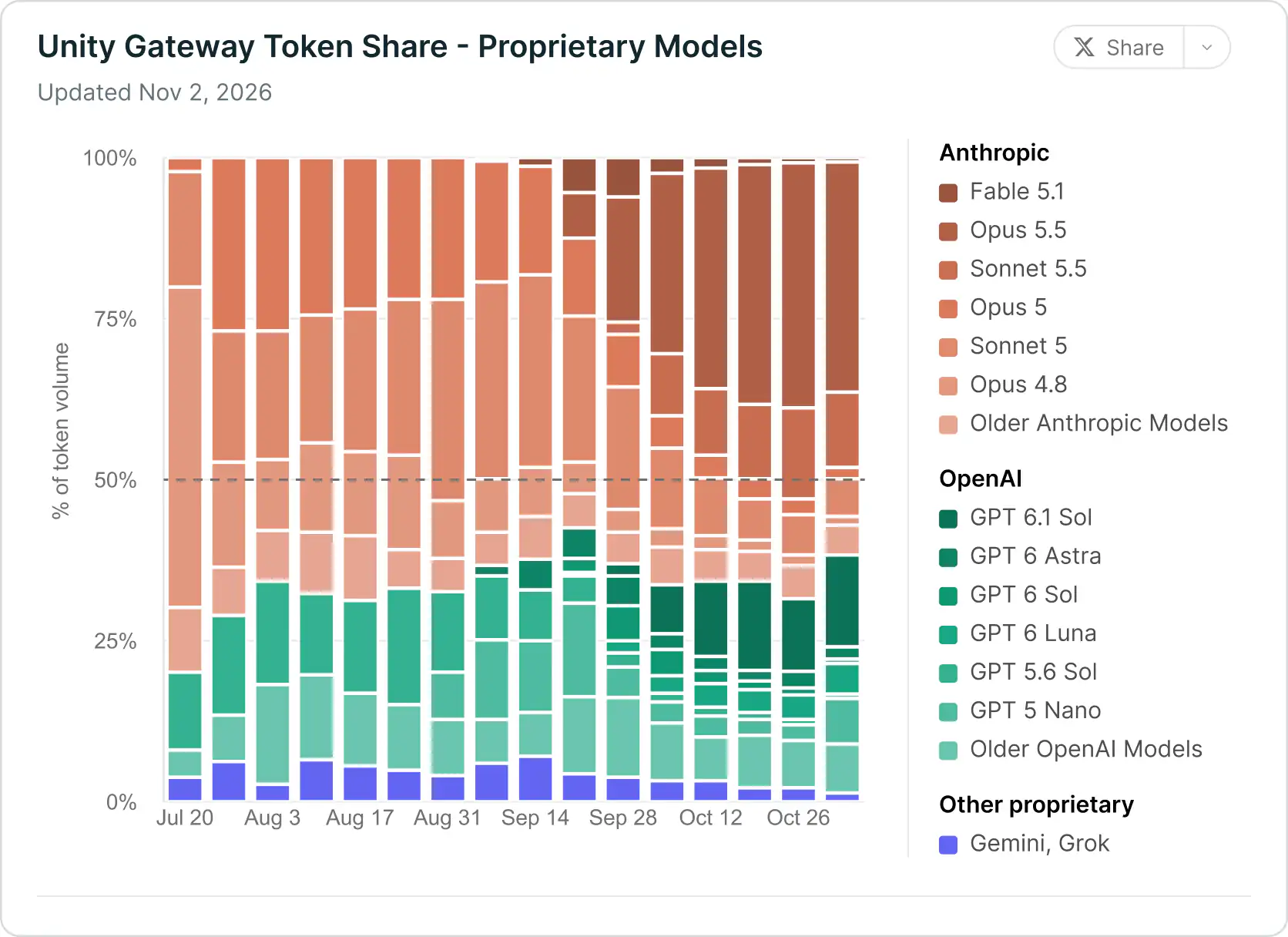
In July, about 64% of companies in the data used just one AI supplier. By 2 November that had fallen to 28%. When Anthropic launched a strong new model, its share of use jumped from 7.2% to 37.9% within six weeks.
Free-to-download models are also gaining ground. Their share of company AI use rose from 7.3% in July to 30.9% in November. Three of them now rank in the top 10 of the coding tests.
A few people run up far bigger bills
The typical user spent just $2.49 on AI in a week. The heaviest 1% spent $699.74 each, about 281 times more. These are usually developers running AI coding tools all day.
Spending by the typical user more than doubled over six weeks, while the heaviest users stayed flat. So everyday use is spreading, while a small group spends far more than everyone else.
What it means for companies in Indonesia
If your team picks AI models by their price list, you may be paying more than you need. The only reliable test is cost per finished task, measured on your own work.
The data also suggests that tying your company to one AI supplier is becoming the exception. Rankings change monthly, and companies that can switch quickly have more choice on cost and quality.
Databricks itself does this. It tests each new model on its own work within days, and it skipped one upgrade after finding the gain was not worth the extra cost.
What to do this quarter
- Ask your teams what each AI tool costs per finished task.
- Pick 2 or 3 real jobs and test a cheaper model against your current one.
- Make sure your systems can switch AI suppliers without a rebuild.
- Look at who your heaviest AI users are. Set budgets and alerts for them first.