
Amazon's AI now grades product pages the way a shopper sees them
Amazon built an AI that judges a whole product page, pictures and text together, and tells sellers what to fix first. Pages revised with its advice scored 1.4 points higher out of 10.

The short version
- Amazon built an AI that scores a seller's product page as one picture, the way a shopper sees it.
- It agreed with expert reviewers far more often than a simpler approach, and it tells sellers what to fix first.
- Pages revised with its advice scored 1.4 points higher on a 10-point scale, and Amazon now uses the scores in its store.
What Amazon built
Brands on Amazon can add a rich section with pictures and video to their product page. Amazon calls it A+ Content. It says sellers with good A+ Content see 8 to 20% more sales than those without it.
The quality varies a lot. A big brand has a design team. A small seller may not.
Checking each image or line of text on its own misses most problems. Amazon's example is a blender page. The bullet points promise a large jug, but the lifestyle photo shows a small single-serve model. Each part looks fine alone. Together, they confuse the shopper, who may simply leave without buying anything.
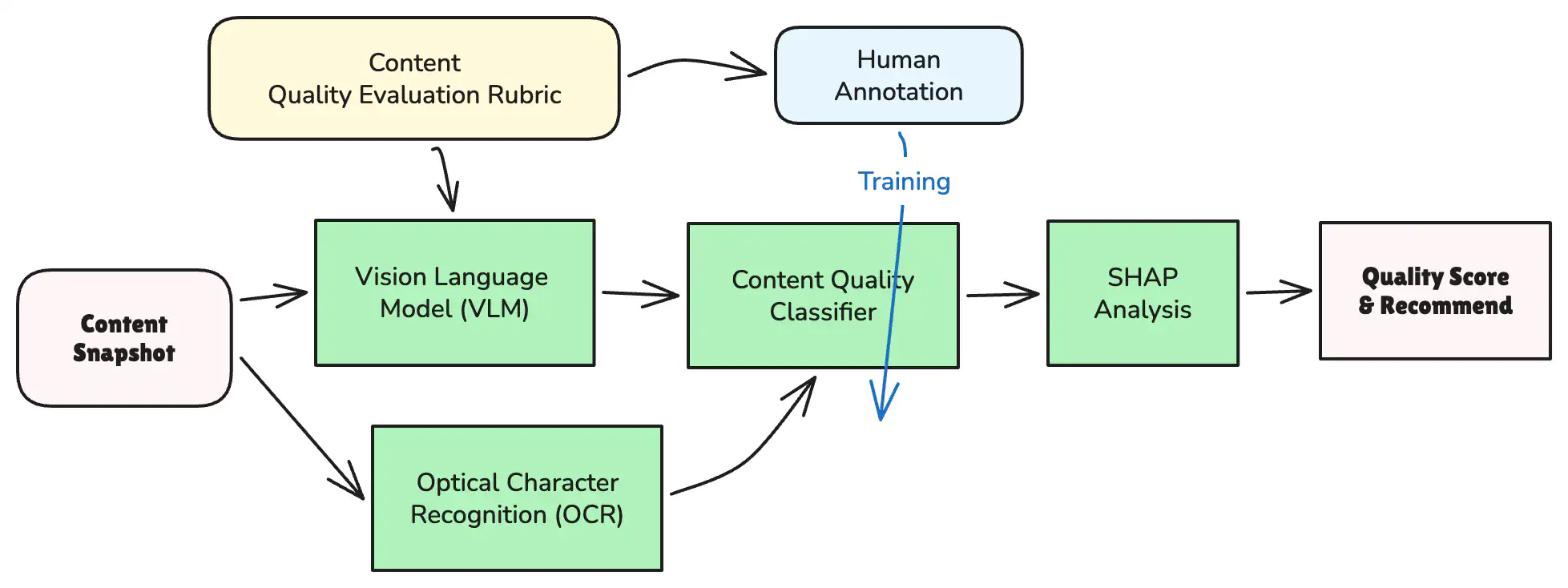
So Amazon's team turns the whole page into one snapshot. An AI that reads images and text scores it on four things: visual story, how features are shown, layout and how well it sells. A second tool measures how crowded the text is. A simple scoring model then combines both and gives a verdict.
To teach it, five trained reviewers rated 5,478 product pages from 10 categories. These ranged from shoes to grocery. Amazon also made it cheap to update. When standards change, only the small scoring model needs retraining, on ordinary computers.
What is actually new
The combined system agreed with expert reviewers almost every time, with an accuracy score of 0.94 out of 1. A simple average of the AI's four scores reached only 0.80.
The surprise was text. Crowded, hard-to-read text was among the biggest reasons a page failed. The AI alone tended to like long, detailed descriptions. Shoppers prefer short text they can scan.
The system also explains itself. It ranks what pulled a page down, then writes plain advice in priority order. Pages revised with that advice scored 1.4 points higher out of 10.
It is already live. In a worldwide test, Amazon showed weak pages less often, and sales rose. Next, it plans to generate improved images for sellers automatically.
Amazon notes one limit. Quality standards differ by language and market, and its experts cannot cover every case.
What it means for brands in Indonesia
You likely sell on marketplaces that rank listings by many factors. Amazon has now shown that a machine can score page quality at scale, and that the score ties to sales. Amazon has published its method in detail, so other platforms can follow it. Expect clear, honest pages to be rewarded more over time.
The lesson works for you today, on any platform. Judge your listing as a whole page, the way a shopper on a phone sees it. Short, readable text matters more than packing in every feature.
What to do next
- Take your 10 best-selling listings and look at each one as a full page on a phone.
- Check that every claim in the text matches what the pictures show.
- Cut crowded text inside images and use fewer, bigger words.
- Put the product before the lifestyle shots, so shoppers see what they are buying first.
- Track sales before and after each fix, one listing at a time.
- Ask the marketplaces you sell on what they measure when they judge a listing.