
ChatGPT can now answer questions using company data kept in Databricks
OpenAI and Databricks have set out how staff can ask ChatGPT about business data under the company's own definitions and access rules. IT keeps control of who sees what and what it costs.
The short version
- OpenAI and Databricks set out how companies can use ChatGPT on business data they already keep in Databricks.
- Staff can ask ChatGPT a business question and get an answer that uses the company's own definitions, like what counts as "revenue".
- Each person sees only the data they are already allowed to see. IT can also cap and track what each team spends.
What the two companies announced
Databricks runs data platforms where large companies store and manage their business data. OpenAI makes ChatGPT and the AI models behind it, plus a coding tool called Codex. On 13 November Databricks published how the two companies' products now fit together.
OpenAI's president, Greg Brockman, said AI without company data is "like hiring someone with 20 PhDs and never inviting them to a meeting."
The companies describe three common starting points.
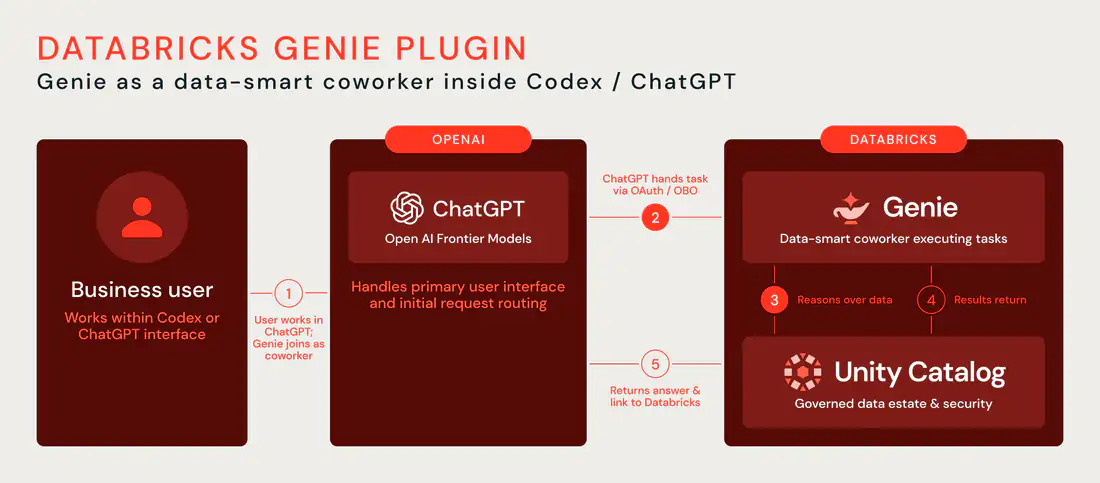
1. Business questions in ChatGPT. A Databricks add-on called the Genie plugin lets staff ask ChatGPT questions about company data. A product manager might ask how weekly active users are tracking against target. ChatGPT passes the question to Genie. Genie applies the company's approved definitions and runs the query. Then it sends back charts.
Databricks stores these definitions in a layer it calls Genie Ontology. So "revenue" in ChatGPT matches "revenue" in the finance reports. Every answer links back to its sources, and users only see data they already have permission for.
2. Coding with spending control. Many firms adopt AI coding tools one team at a time. Leaders then lose track of who uses them and what they cost. Databricks' Unity Gateway sits between the engineers and OpenAI. Engineers keep using Codex as before. The gateway logs every request, so engineers never handle the company's OpenAI login. Leaders can set budgets by team and choose which model handles which task.
3. Custom AI helpers next to the data. OpenAI's models can now run inside Databricks, beside the governed data. Teams can build their own AI helpers there without managing a separate OpenAI key.
How close the two companies are
The relationship runs both ways. Each company is a customer of the other. OpenAI is one of Databricks' largest customers, and every Databricks engineer is getting Codex. Databricks also gets early access to new OpenAI models.
ChatGPT can now connect to Databricks in one click with no admin setup. It applies each user's existing permissions. Databricks says it will publish a detailed post on each of the three patterns over the coming weeks.
What it means for companies in Indonesia
In many large firms, data sits in many places with no agreed definitions. Two branches count "active customer" differently, and two reports disagree.
This launch shows where the leaders are heading. Staff ask the AI assistant, but the answers should come from one checked set of company figures. If that layer is missing, a chat assistant gives fast answers that may be wrong.
The spending controls matter too. AI tools spread quickly once staff try them. Firms that can see costs by team, and set limits, avoid a surprise bill.
For companies already on Databricks, the step is short. For everyone else, agree on your core business definitions before you let staff ask an AI about them.
What to do next
- List the figures your board asks about most. Check that every team defines them the same way.
- If you use Databricks, test the Genie plugin on one team with a clear set of approved metrics.
- Send all AI coding tools through one approved route, so you can see usage and cost by team from day one.
- Check that your data access rules are up to date before connecting any AI assistant to them.