
Runway's robot AI is now free for any company to download and adapt
Runway, known for AI video, released a model that controls robot arms after learning from everyday video. Robot makers can now run and adapt it on their own hardware, including for commercial use.
The short version
- Runway released Praxis-1, an AI model that controls robots, free to download under a license that allows commercial use.
- It learned how objects and tasks behave from large amounts of everyday video, then from robot footage.
- On an NVIDIA simulation test of 120 tabletop tasks, it succeeded in 46.2% of attempts. That is the best of any free robot model on the list.
What Runway released
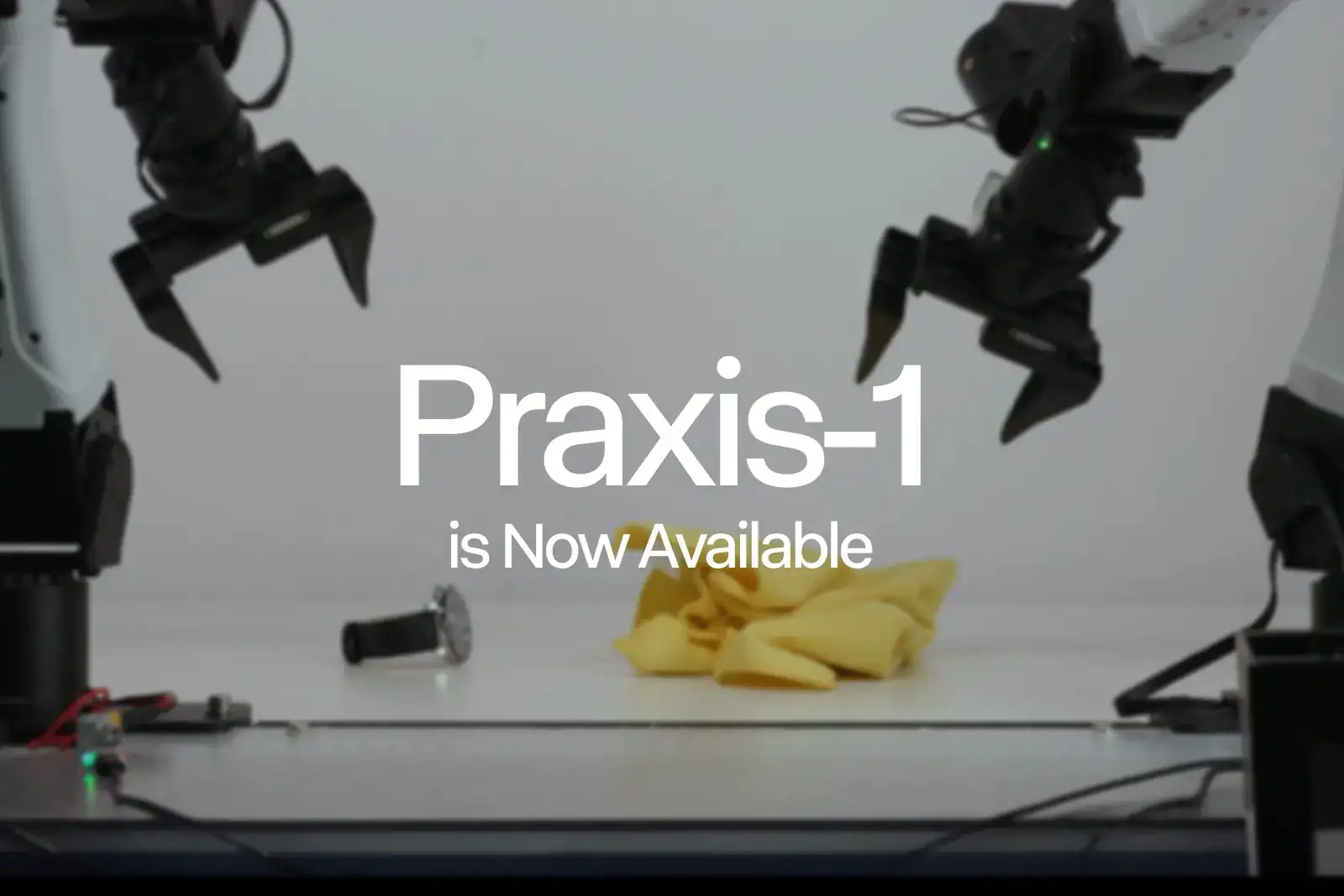
Runway is best known for AI video tools. Praxis-1 turns that video work into robot control. It predicts what the scene will look like next, and the motion that will get the robot there.
Runway first showed Praxis-1 in September. Launch partners have run it on a walking humanoid robot and an industrial arm. A third partner used a two-armed warehouse robot.
Now anyone can download it under an open license. The release covers the model and the code to run and retrain it. It runs on NVIDIA hardware, from data center chips to the computer inside the robot.
Why everyday video matters for robots
Robot training data is scarce. Collecting it means people steering robots by remote control, task after task. That is slow and costly.
Runway's bet is that ordinary video can fill much of the gap. A model that has watched a lot of video already knows how hands move and how objects behave. Runway says its research found that web video worked as well as remote-controlled robot video for this early training.
Most of the video it learned from shows people doing everyday jobs from their own point of view. That includes cooking, cleaning, assembly and packing.
The test results support this. On NVIDIA's RoboLab-120 test, Praxis-1 succeeded in 555 of 1,200 attempts, or 46.2%. The next best model on the list scored 42.9%.
It also adapts to robots it has never seen. Praxis-1 was never trained on Google's RT-1 robot. After light retraining, it reached 80.0% success on a simulation test with it. RT-1's original software scored 52.4%.
The real-world tasks Runway shows are simple but useful. A robot places a mug upside down on a tray. It puts an item in a box and closes the lid. It clears bottles into a bin and closes a drawer.
What it means for factories and warehouses
A 46.2% success rate is not ready for a production line. A factory needs far higher reliability. Treat it as a base for pilots.
The free release lowers the cost of trying. A company that installs robots can now take one free model and adapt it to its own machines and tasks. Runway says this works without retraining the whole model.
That could matter for plants that run equipment from several makers. One model that adapts to different robots is easier to manage than a different system for each.
The model also improves with more training. Runway tested earlier versions of it on the same simulation. Longer training lifted their score from 25.5% to 41.2%, where it leveled off.
Speed is workable too. On a single NVIDIA H100 server, each call takes about 0.55 to 0.6 seconds. That is about a third of the 1.6 seconds of motion each call returns.
What to do next
- Ask your automation partners whether they are testing free robot models like this one.
- Pick one repetitive handling task, such as packing, as a candidate for a small pilot.
- Plan for safety checks and close human oversight. A model that fails about half the time in simulation needs a person watching in a real plant.
- Check the public leaderboards every few months. Success rates for these models are moving quickly.