
The firms earning 4x on AI also lead on staff training, a survey finds
IDC's study for Microsoft finds the top 10% of companies report about 4x return on AI. They spend ahead of plan, set rules for AI agents and train staff across the company.
The short version
- A survey of more than 5,200 business and IT leaders finds that most firms get results from AI, but fewer than half spread it across the business.
- The top 10% of firms report about 4x return on their AI spending. They also lead on staff training and on rules for AI agents.
- In Indonesia, 11% of firms surveyed made that top group, the same share as across Asia Pacific.

What the survey found
Research firm IDC ran the study for Microsoft for the fourth year in a row. It asked more than 5,200 senior leaders across 28 industries what it takes to get value from AI as it grows. In Asia Pacific, 1,964 leaders in nine markets took part, including Indonesia.
IDC ranks every firm on a maturity scale. It looks at spending discipline and how widely AI is used. It also weighs the use of AI agents, staff skills, confidence in managing risk, and results. The top 10% are called Frontier Firms. The bottom 30% are called slow adopters.
Results are now common. 66% of leaders say AI has already delivered major results. But only 48% are spreading that value across several business units. And 36% of organizations are still only piloting AI agents, software that carries out tasks on its own.
What the leading firms do differently
Frontier Firms report an average return of 4x on their AI spending. Slow adopters report 2.7x. The gap is wider at the top end. 39% of Frontier Firms see 5x or more. Among slow adopters, 4% do.
These are leaders' own estimates. IDC says these habits and higher returns go together. It does not prove one causes the other.
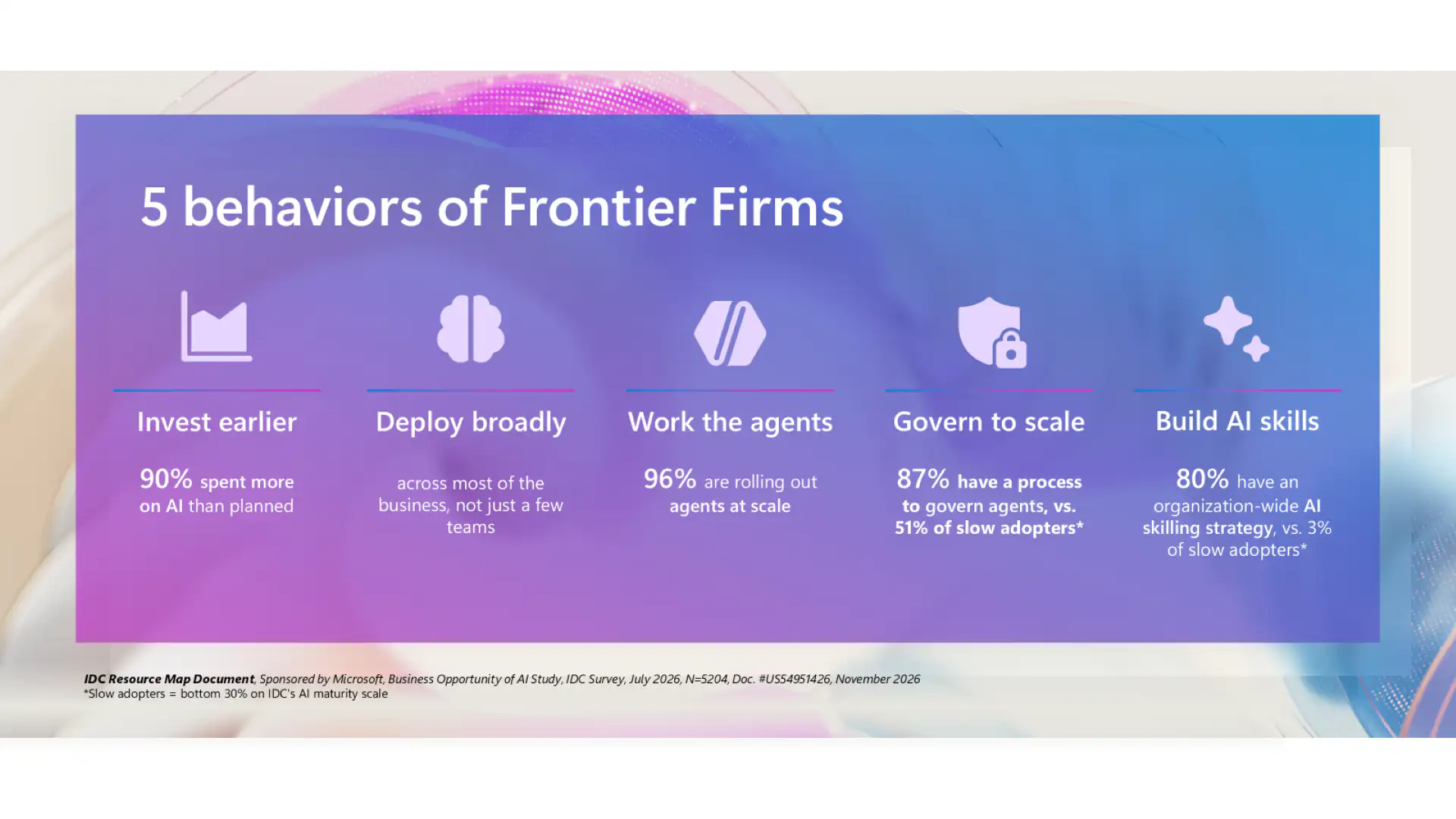
The habits of the leading group stand out:
- They spend ahead of plan. 90% spent more on AI than they had planned.
- They use it widely, across most of the business rather than in a few teams.
- They put agents to work. 96% are rolling out AI agents at scale.
- They set rules for agents. 87% have a process to govern and oversee them, against 51% of slow adopters.
- They train everyone. 80% have a company-wide plan to build AI skills. Among slow adopters, just 3% do.
Measurement is another dividing line. Only 61% of all organizations are highly confident they can measure what AI is worth. Among Frontier Firms, the figure is 93%.
The biggest gap is people
Staff trust AI more than companies prepare them for it. 67% of firms say their workforce reports high trust in AI. Only 20% have a full, company-wide training plan.
Rules for AI agents show a similar gap. 65% of organizations have an established process to govern AI agents. Yet only 60% feel highly confident they can handle AI's security and governance risks.
What it means for companies in Indonesia
Asia Pacific is spending fast. In the regional results, 76% of firms expect their AI budgets to rise sharply next year. Globally the figure is 71%.
Asia Pacific firms are also a little ahead on control. 72% govern AI agents with an established process, against 65% worldwide. But 30% let agents make all decisions without human approval. That is a risk worth checking in your own business.
Indonesia sits in the middle of the region. Its share of Frontier Firms is 11%. Hong Kong leads at 20%, with Singapore at 17%.
The leaders pair spending with company-wide training. They also set rules for agents and measure what AI returns.
What to do next
- Ask how your company measures what AI returns today. If nobody can answer, start there.
- Write a training plan that reaches every level of staff, not only the technical teams.
- Set a review process for AI agents before you let them make decisions, and decide which decisions always need a person.
- Track AI spending and results by business unit, so budget goes where it pays back.