
Meta's AI agents now help tune its ad system, cutting months to weeks
Meta says a system that shares out computing power across ad requests has improved its ad ranking by about 10%. AI agents now propose and test many of its changes, with engineers approving each one.

The short version
- Meta built a system called Intelligent Delivery. It decides how much computing power each ad request gets, and where it runs.
- Meta says it improved ad ranking by about 10% between 2017 and mid-2026. That is on top of gains from better models.
- AI agents now help tune it. In the first half of 2026 they contributed to about 20% of its improvements. On its most automated part, they did about 80% of the engineering effort.
What Meta built
When someone opens their feed, the app asks Meta for ads to show. Over the next few hundred milliseconds, Meta decides which ads to show.
Meta can't give every request the same effort. Its ad models are growing faster than the hardware that runs them. So it has to decide where each unit of computing power does the most good.
Some requests gain a lot from extra effort, and others gain little. Meta used to sort requests into groups with rules that engineers wrote. That stopped working at scale, because every new signal multiplied the rules.
Now an AI model predicts, for each request, how much extra computing would improve the result. In Meta's offline tests, it picked out the requests that gain most from extra effort about 20% more accurately than the model before it.
The system then makes a chain of choices for each request. Which data center region serves it? Which kind of chip runs it? How much of a machine does it get?
When a machine is busy, it first cuts the costly work that adds least. Meta's fleet mixes chips from several makers, including its own. Each kind suits a different job, so matching work to chips matters.
Where the AI agents come in
Every new model or chip changes what the best settings are. There are millions of settings, far too many to test one by one. Engineers used to rely on experience to pick promising ones.
Meta first tried a fixed mathematical method to search the settings. It helped, but it was slow and could only handle a few of them.
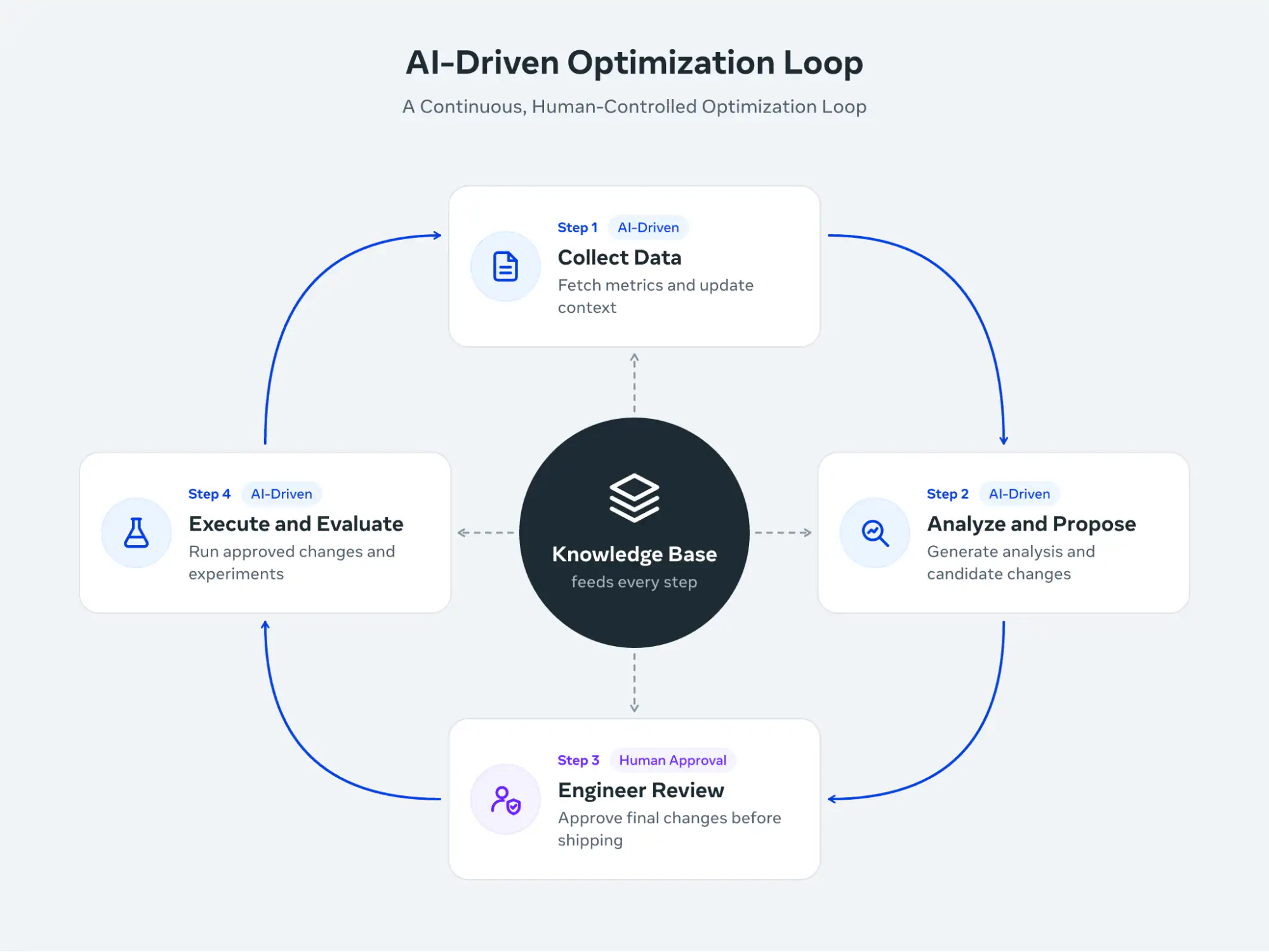
Now AI agents watch the system and look for wasted computing and settings worth changing. An agent reads the code and design documents. It also reads a decade of experiment logs. It narrows the options down to a handful of changes worth testing. Then it designs and runs the experiments.
Engineers still approve every change before it ships. Meta says this shortens the tuning cycle from months to weeks. It also keeps what engineers have learned over the years in a shared knowledge base, rather than in people's heads.
What it means for advertisers in Indonesia
You can't switch any of this on. It runs inside Meta for every advertiser on Facebook and Instagram, and it affects you in two ways.
First, the effort Meta spends on your ad depends partly on choices you never see. Meta's system decides, request by request, where extra computing pays off most.
Second, Meta keeps changing the machine under your campaigns, and faster than before. Results can move even when you changed nothing.
Meta's way of working is also worth borrowing. It lets AI agents search for improvements and run the tests, while a person keeps the final say. That pattern fits other large operations too, such as pricing or stock planning.
What to do next
- Judge Meta campaigns over weeks, not days. Short swings may come from changes on Meta's side.
- Keep a simple log of your own campaign changes, so you can tell your moves from the platform's.
- If you run large systems yourself, pick one tuning job where an AI agent could propose and test changes. Keep a person approving each one.
- Ask which of your decisions still rely on one engineer's memory. Meta found that approach didn't keep up as its systems grew.